
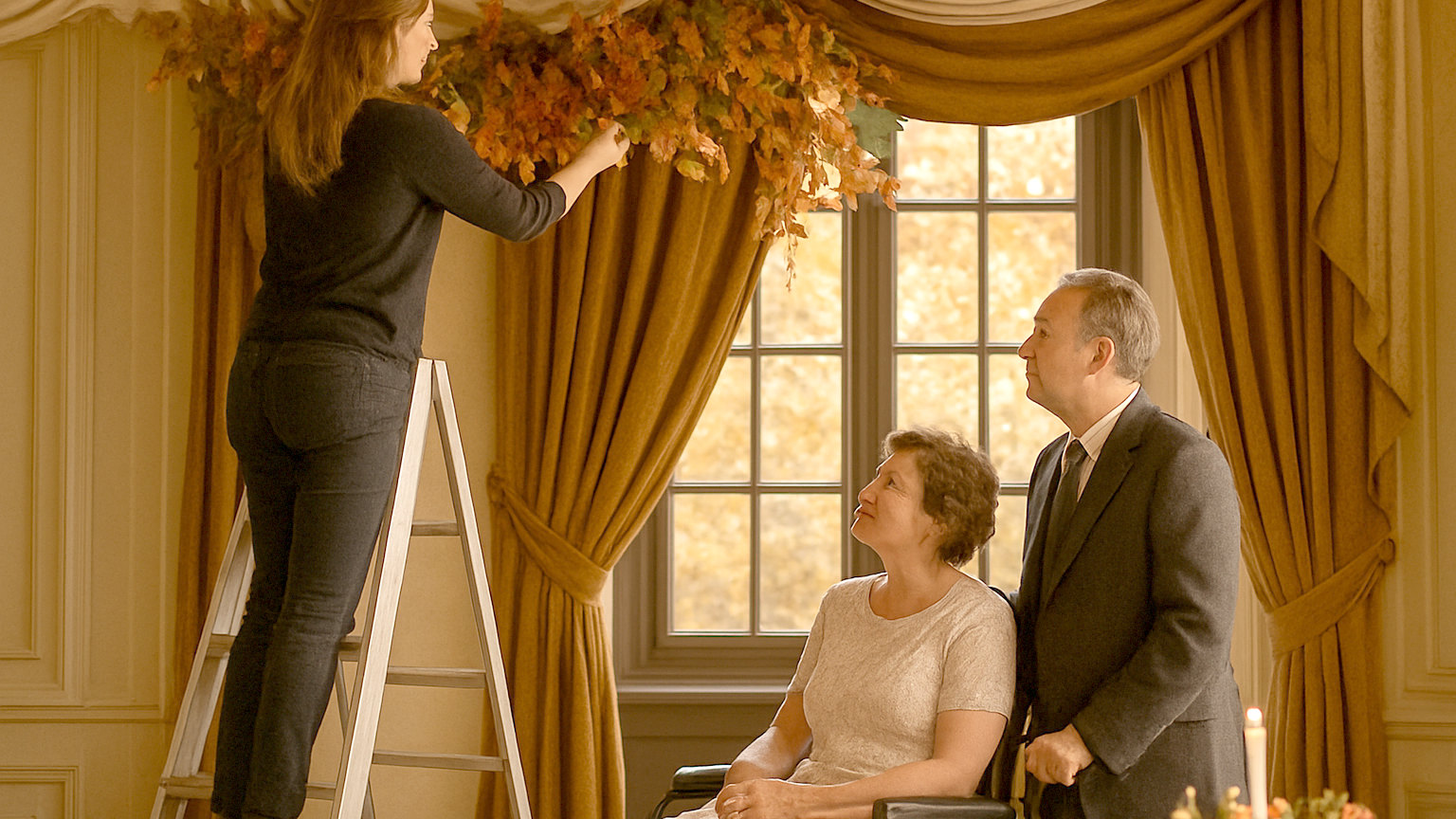
Drapes and backdrops are among the most expensive styling items and among the few that solve problems nothing else can. Whether they are worth it depends entirely on what is wrong with the room.
What do ceiling drapes do?
Hide an unattractive ceiling and lower the apparent height of a room. In a function space with exposed services or a marquee with a bare structure, they transform the space.
In a room with a good ceiling they achieve nothing and cost a great deal. That is the test.
Why are they expensive?
Because covering a large area at height takes time, structure and usually two or three people. The fabric is a minority of the cost and the installation is most of it.
The same applies to takedown, which happens late at night or the following morning and is real labour.
What does a backdrop do?
Gives a focal point. Behind a ceremony, a top table or a cake, it directs attention and gives photographs a defined background rather than a wall and a fire exit.
It is the single most photographed piece of styling at most weddings, which is why the money frequently justifies itself.
What are the options?
Fabric panels, floral or faux floral walls, greenery, frames, arches, hedging and increasingly hired installations that arrive complete.
Hiring is usually far cheaper than commissioning, particularly for anything floral, and it removes the disposal problem afterwards.
Can a backdrop be moved?
Frequently, and it is worth planning for. A ceremony backdrop relocated behind the top table during the drinks reception is used twice for one cost.
It has to be arranged in advance because somebody must move it, and it needs to be in the quote and the running order.
What about wall drapes?
Useful for covering an unattractive wall, a bank of windows at night or a doorway that should not be visible. Less transformative than ceiling drapes and considerably cheaper.
Combined with uplighting they change a plain wall entirely, which is frequently the cheapest way to improve a bare function room.
What should you check with the venue?
Fixing points, weight limits and whether an approved contractor is required for work at height. Many venues restrict all three.
Ask about fire regulations too, since fabric used in a venue generally has to meet a flame retardancy standard and the supplier should be able to certify it.
Are they worth it?
In a marquee, a bare function room or anywhere with a genuinely poor ceiling, yes, and there is no cheaper solution to that particular problem.
In a room with character, no. Draping a beautiful ceiling is spending several thousand pounds to hide the reason you booked the venue.
What is the cheaper alternative?
Lighting, which draws the eye downward and away from a ceiling rather than covering it. Festoons at head height do a surprising amount of the same work.
Where the budget will not stretch to drapes, uplighting and dimmed overheads is the substitute, and at a fraction of the cost it gets most of the way there.
Where should a backdrop go?
Behind whatever gets photographed most, which is the ceremony position and the top table. Those two locations produce the majority of the images from the day.
Ask the photographer where they will be shooting from before deciding the position. A backdrop placed without that conversation frequently ends up outside the frame.
How far ahead should they be booked?
Six months or so for anything hired at a peak date, since suppliers have a finite stock and one set of drapes cannot be at two weddings.
Are they worth the money?
Where the ceiling is genuinely poor or the room has no focal point, yes, and nothing else solves those problems. Anywhere else the same budget buys more elsewhere.
What is the cheaper substitute?
Lighting for a ceiling problem and a well chosen position for a focal point problem. Both cost a fraction and both get most of the way there.


