
Almost every venue has something you would rather was not there. A patterned carpet, a bar sign, a fire exit in the photographs or a dated ceiling. Some of these can be dealt with and some have to be accepted.
What can be hidden?
Walls and ceilings, with drapes, and anything at eye level with freestanding items placed in front of it. Both cost money and both work.
Doorways, service areas and fire exits can usually be screened, subject to fire regulations, which are not negotiable and mean nothing can block an exit route.
What about the carpet?
The most common complaint and the hardest to solve. Carpet cannot be covered across a whole room at sensible cost, and patterned carpet is a feature of a great many older function venues.
The realistic approach is to draw the eye upward and away, with lighting, tall centrepieces and a defined focal point. It works better than people expect.
Can lighting help?
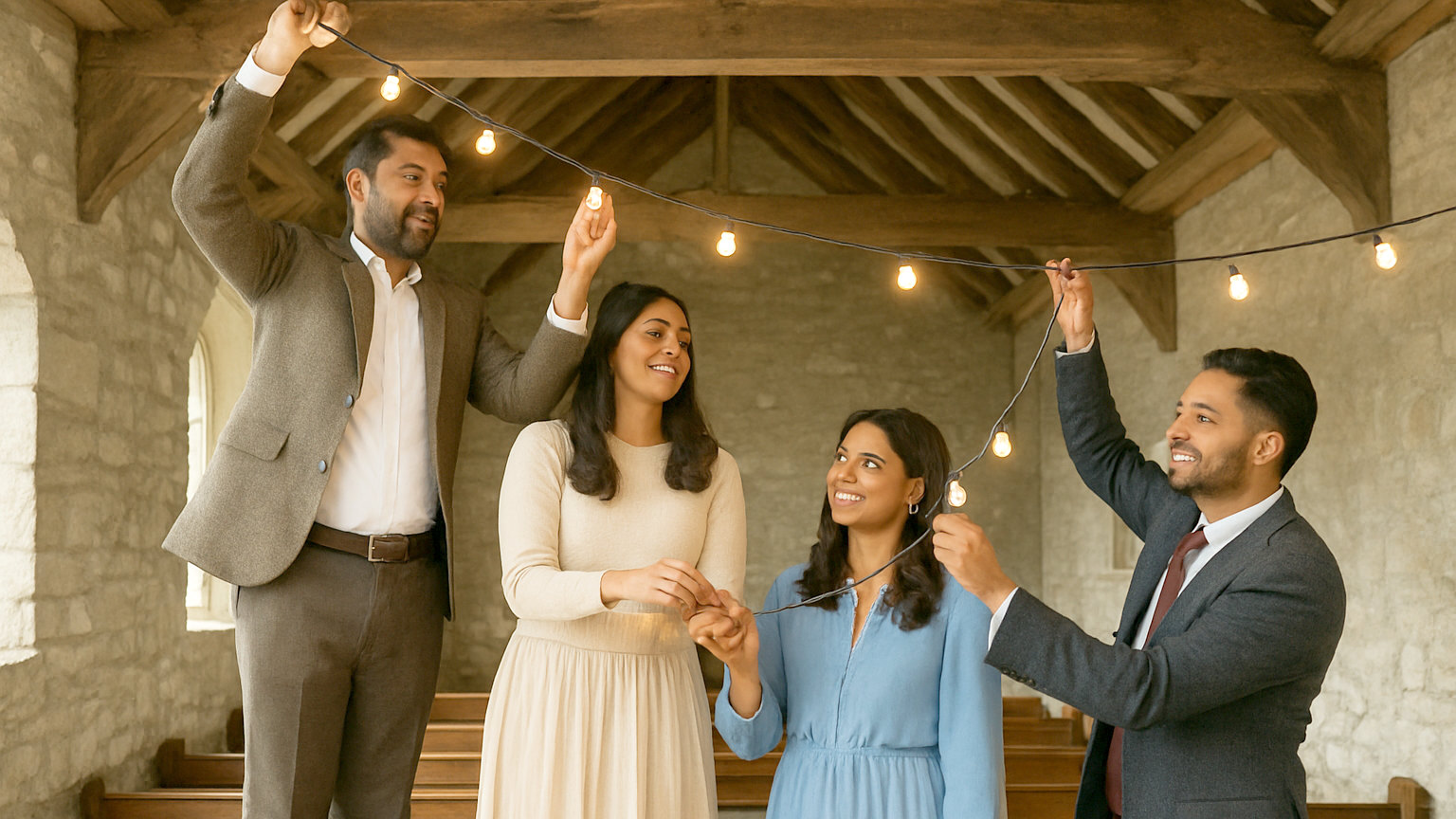
Enormously, and it is the cheapest tool available. Dimming the overheads and lighting the room at eye level means the floor and ceiling recede from attention entirely.
Uplighting on the good parts of a room draws the eye to them. Photographs follow the light, which is why a badly lit room shows every flaw and a well lit one shows almost none.
What about strong existing colours?
Work with them rather than against them. A room with red and gold will not become neutral, and a cool scheme in it looks like a mistake rather than a contrast.
Choose the palette from photographs of the actual room. It is a small step and it prevents the most common styling failure.
What can be moved?
Less than you would hope. Ask the venue what furniture and fittings can be removed or relocated, since some are fixed and some are simply never asked about.
A room with a dated bar or a large mirror occasionally improves considerably by moving one item, and it costs nothing to ask.
What should be left alone?
Anything that would cost more to hide than the room is worth. If a venue needs several thousand pounds of drapes to be acceptable, the honest answer is usually a different venue.
That is a decision to make at the viewing rather than after the deposit, which is the argument for looking properly rather than at the best corner.
How do you handle it in photographs?
Tell the photographer at the briefing stage. They shoot around unwanted features constantly and will simply choose angles that exclude them.
Ask which parts of the room they would use. Their answer frequently makes half the problem irrelevant, since nobody photographs the wall you were worried about.
What is the cheapest fix?
Rearranging the layout so guests face the good part of the room. It costs nothing and it solves more than decoration does.
Where the top table faces a fire exit, turning the whole plan ninety degrees is free and changes every photograph taken during the speeches.
What is the honest position?
Most venue flaws matter far less than they appear at an empty viewing. A room with a hundred and fifty people, dimmed lighting and candles looks nothing like the same room at eleven in the morning.
Deal with what can be dealt with cheaply, light the room properly, and let the rest go. Guests do not examine the carpet.
What should you check at the viewing?
Whether it can be moved, covered or lit around, and what the venue permits. Asking at the viewing costs nothing and occasionally reveals that the thing you disliked is removable.
When does it become a reason to look elsewhere?
When hiding it would cost more than the room is worth. If a venue needs several thousand pounds of drapes to be acceptable, that is a venue decision rather than a styling one.
Most of it matters far less on the day than at an empty viewing. A full room, dimmed lights and candles hides a great deal that seems glaring at eleven in the morning.


