
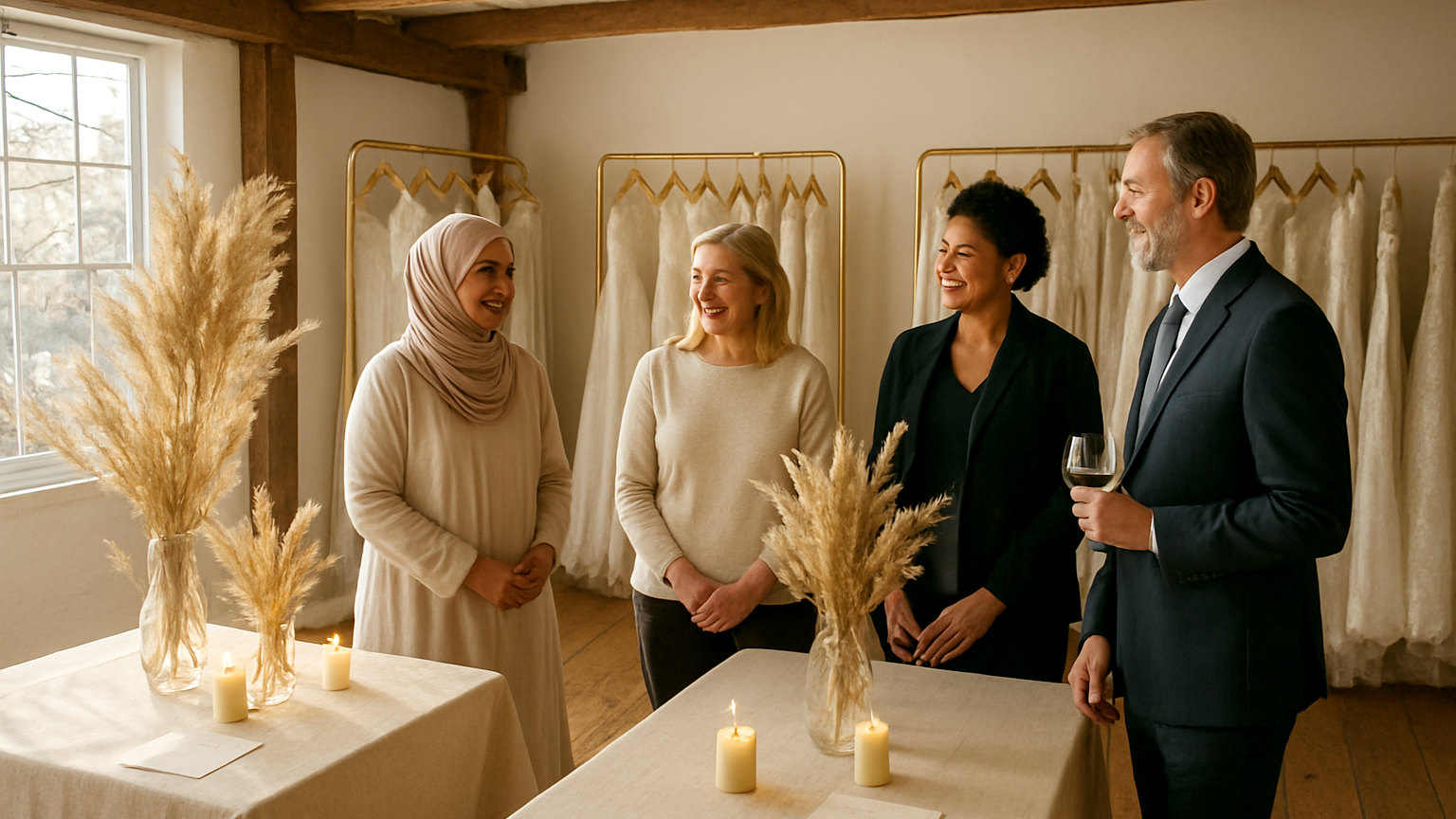
A venue with strong architecture, good light or a view arrives most of the way styled. The work is restraint rather than addition, and the most common mistake is treating it like a blank space.
Why does less work better?
Because the room already has a focal point and a character, and adding a competing one produces two schemes fighting each other.
Guests look at what is most striking in a room. If that is a stone fireplace or a window, decoration nearby is looked past rather than at.
What should you add?
Whatever the room lacks rather than whatever you like. A dark panelled room lacks light. A grand hall lacks warmth. A gallery lacks softness.
Identify the gap at the viewing and style to fill it. That produces a coherent room and it is usually cheaper than a full scheme.
How do you handle strong existing colours?
Work with them. A room with red carpet and gold fittings will not become neutral, and a scheme in cool greys will look like it was designed elsewhere.
Photograph the room and choose the palette against those photographs rather than against images of another venue.
What should you avoid covering?
Whatever the venue is known for. Draping a beautiful ceiling, obscuring a window with a backdrop or placing a flower wall in front of stonework is spending money to hide the reason you booked it.
If something in the room is worth photographing, the styling should frame it rather than compete with it.
Where should the budget go?
Tables and lighting, which are the two places a characterful room still benefits. Everything else is frequently unnecessary.
A room like this is where a styling budget can be genuinely small, and the saving is real rather than a compromise.
What are the restrictions?
Usually more than at a modern venue. Listed buildings commonly prohibit fixings entirely, restrict naked flames and limit what can be moved.
Ask early and plan freestanding. Anything requiring attachment is likely to be refused and it is better to know before designing around it.
How does it affect the photographs?
Well, which is part of the value. A characterful room gives a photographer backgrounds without any styling at all, and that reduces what you need to create.
Ask a photographer who has worked there where they shoot. Their answer tells you which parts of the room matter and where decoration would be wasted.
What about the ceremony?
Frequently nothing is needed beyond the chairs. A licensed room in a historic building rarely benefits from an arch or a backdrop and often looks worse with one.
Where something is wanted, keep it low and to the sides rather than behind, so it frames rather than blocks.
What is the honest advice?
Spend the styling budget on the venue rather than on decorating it. A building that does the work is worth paying more for and costs less to dress.
Couples who choose a characterful venue and then style it as heavily as a function room have paid twice for the same effect, and the result is usually worse than either alone.
What should you ask at the viewing?
What most couples do here, and what the venue would advise against. A team who runs weddings in that room weekly knows exactly which schemes work and which fight the building.
They will usually tell you plainly if asked, and it is free advice from the people who have seen it attempted a hundred times.
What does this do to the budget?
Reduces it substantially, which is part of what a more expensive venue is buying. A building that dresses itself needs a fraction of the styling spend a function room requires.
What is the test for adding anything?
Whether it improves the room or merely fills it. If a piece would look equally at home in a different venue, it is probably filling rather than improving.


