
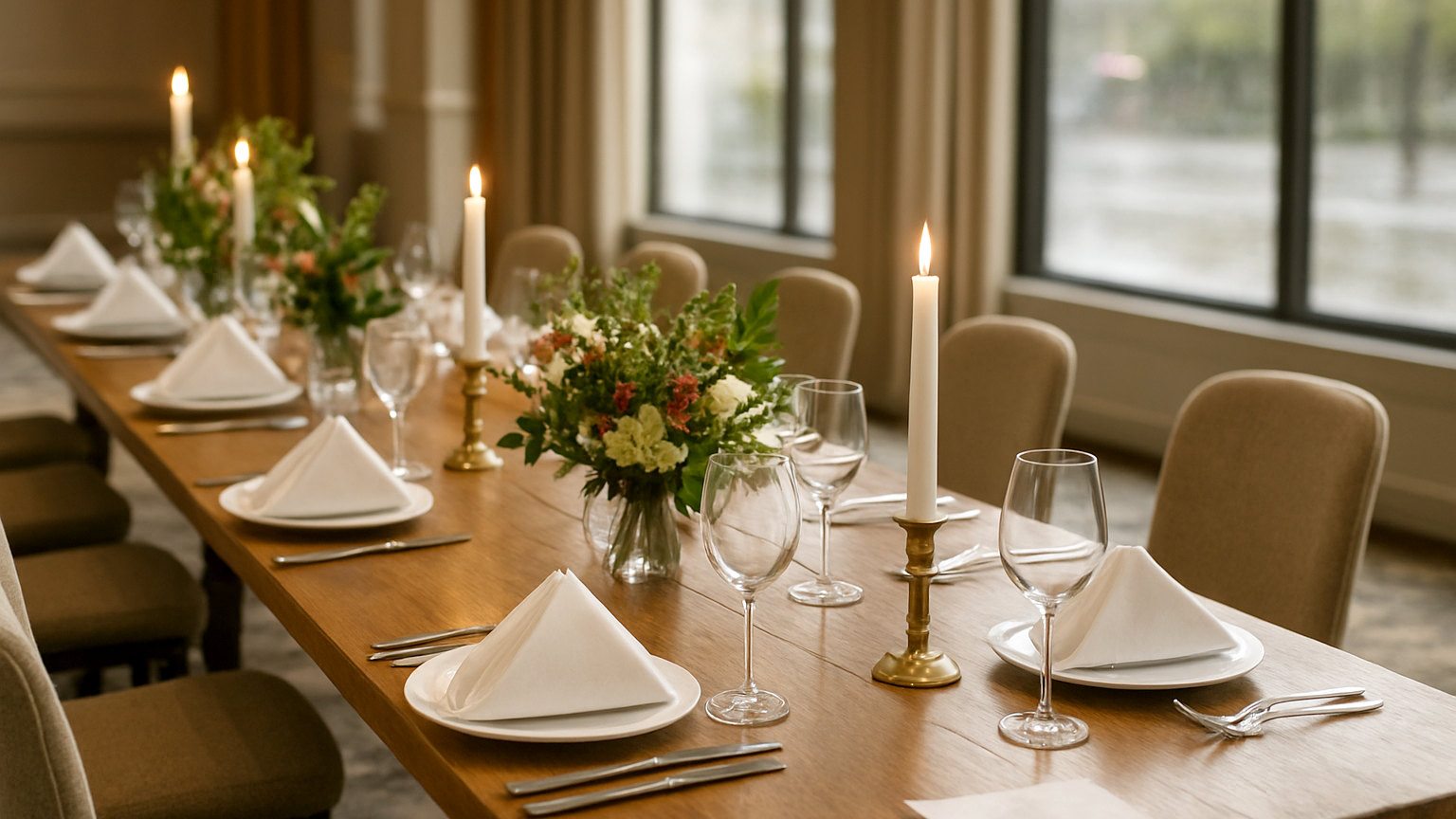
A small wedding in a room built for a hundred and fifty feels empty, and the problem is harder to solve than a room that is too small. Matching the venue to the guest list matters as much at forty guests as at a hundred and forty.
Why does an oversized room feel wrong?
Because a wedding is partly about density. Forty people spread across a large hall produce a quiet room with empty corners, and the atmosphere never quite builds.
The same forty people in a room that comfortably holds fifty feels full, warm and busy. That is not a small difference and it costs nothing to get right.
What capacity should you look for?
A room whose comfortable seated figure is close to your guest number rather than well above it. Slightly under capacity is better than substantially over.
Ask the venue how a wedding of your size looks in the room, and ask for photographs at that number rather than at their maximum.
Can a large room be reduced?
Sometimes, and it is worth asking. Screens, drapes, a smaller layout at one end, or using only part of the space all help.
Some venues have a smaller room they use for smaller weddings. Ask rather than assuming the main hall is the only option.
What is the real obstacle?
Minimum spend and minimum numbers. A venue with a minimum designed around a hundred and twenty guests is unreachable at forty, and you pay for people who are not there.
That is the most common reason a small wedding budget fails at a conventional wedding venue, and it is avoidable by asking in the first enquiry.
Where should you look instead?
Outside the wedding venue category. Restaurants with a private room, small hotels, pubs with function space, village halls, gardens and members clubs generally have no minimum.
A restaurant charging a per head price with no hire fee is usually better value below about fifty guests than a wedding venue running under its own minimum.
What works well at small numbers?
One long table seating everybody, which is only possible at smaller weddings and is frequently the thing couples most enjoy about them.
It changes the meal entirely. Everybody is part of one conversation and the speeches are addressed to a table rather than a room.
Does the ceremony space change?
It should. A ceremony for thirty in a room licensed for a hundred and fifty produces rows of empty chairs, which photographs poorly.
Ask whether chairs can be removed and the seating arranged closer, or whether a smaller licensed room is available.
What about the evening?
A small wedding does not need a large dance floor, and a room that felt right at dinner may feel sparse once tables are cleared.
Ask the venue how they handle the evening for smaller numbers. Keeping the space tighter is usually better than opening it up.
What should you ask?
The comfortable seated figure, whether a smaller room exists, whether there is a minimum spend or minimum number, and what a wedding at your size looks like there.
Four questions in the first email. They will remove most venues that were never going to work and identify the ones that suit a smaller wedding properly.
Does the venue want your booking?
Worth considering. A venue built for large weddings taking a small one is frequently doing so reluctantly, and it shows in the flexibility and the attention.
Somewhere that hosts small weddings regularly will be better set up for it and better company all year, which matters more than the room itself.
What is the best test?
Ask to see photographs of a wedding at your guest number in that room. An empty space and a styled shoot both mislead, and a real wedding at forty guests tells you immediately whether the room works.
Above all, ask about minimum spend in the first email. It is the figure that decides whether a venue works for a small wedding, and it is almost never in the brochure.


