
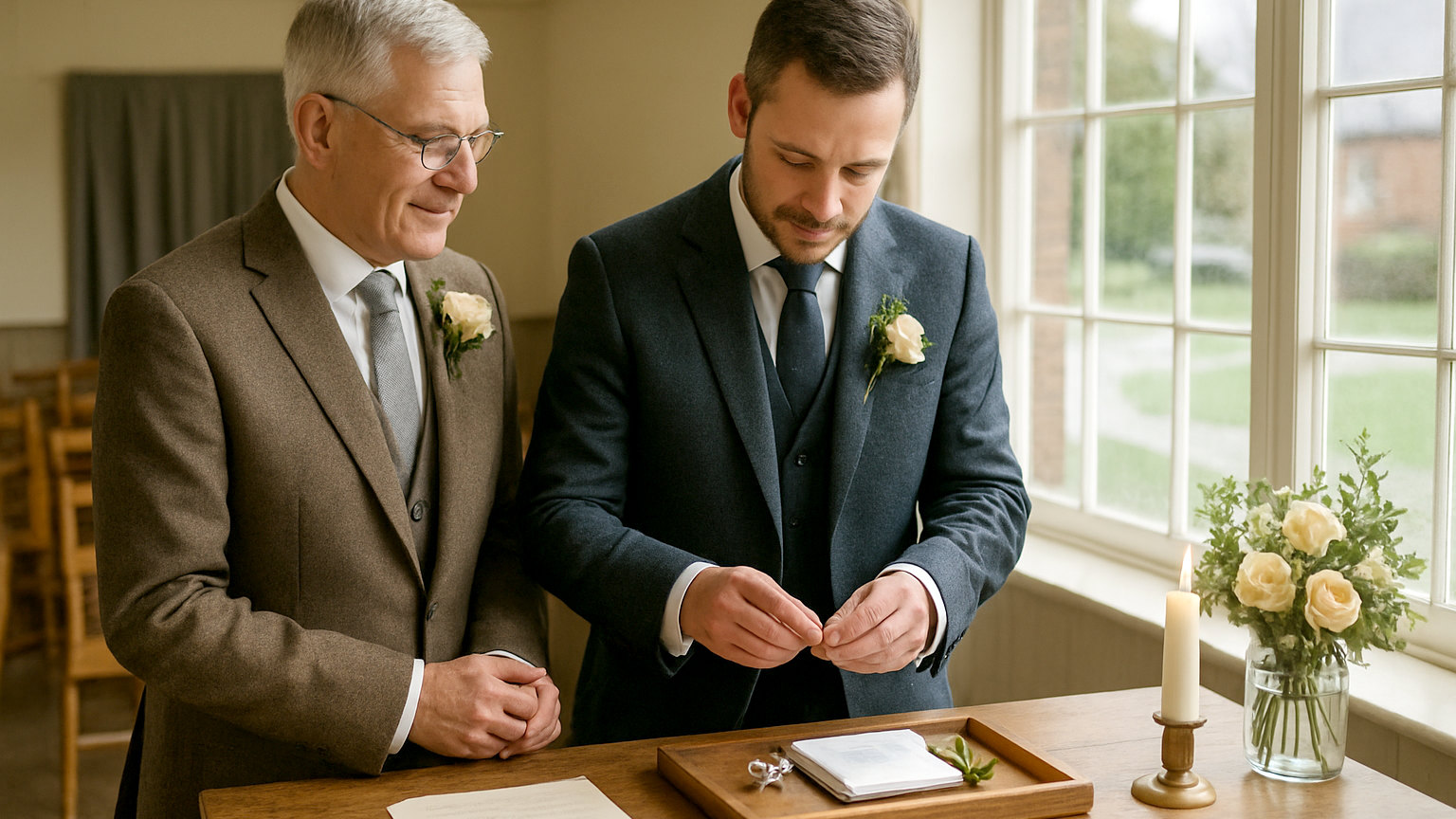
Menswear needs considerably less lead time than bridal, which is exactly why it gets left too late. Three months is comfortable for every route and six weeks removes most of the options.
What are the lead times?
Made to measure commonly needs eight to twelve weeks including a fitting. Hire needs a few weeks for fittings and collection. Off the peg needs only the time to have it altered.
Alterations on a bought suit take one to three weeks depending on the tailor and the season.
When should you start?
Around four months out if you want made to measure, and three months for everything else. That allows for fittings, alterations and one thing going wrong.
Earlier than that is rarely useful. Bodies change over a long engagement and a suit fitted a year ahead may need refitting anyway.
What is the actual deadline?
Six weeks out for a bought suit and its alterations, and about the same for hire fittings. Below that, made to measure is gone and the alterations are rushed.
Four weeks is achievable off the peg with a fast tailor and it removes any margin for a problem.
Why does it get left?
Because everybody knows it is quicker than the dress, and that is true right up until several people need coordinating and one of them is abroad in the relevant fortnight.
The wedding party is what turns a simple job into a scheduling problem, and it is the reason to start earlier than seems necessary.
What about the wedding party?
Set a deadline six weeks out for everybody to be fitted, and expect at least one person to be late. Build the margin in rather than assuming.
Give the chasing to the best man or one member of the party. It is a bounded job that people are happy to take and it should not be the couple.
When does the season matter?
Hire companies and tailors are busiest between May and September, so lead times lengthen and fitting appointments are harder to get.
Ask for the lead time for your specific date rather than the general figure, exactly as you would with a dress.
What can be left late?
Shirts, ties, pocket squares, cufflinks and socks, all of which can be bought in a fortnight. Shoes should be earlier, since they need wearing in.
Buttonholes are ordered with the flowers and confirmed around four to six weeks out with the rest of the floral brief.
When is the final fitting?
One to two weeks before the wedding, which is late enough to be accurate and early enough to fix anything.
Take the shirt, shoes and waistcoat. All three affect the fit and the hem, and none of them can be assumed.
When is collection?
A few days before for hire, and whenever it is ready for a bought suit. Try everything on together once it is home rather than assuming.
Hang it properly rather than leaving it in the bag in a car, and steam or press it the day before rather than the morning.
What about returns?
Assign them in advance. Hired outfits go back within a stated window, usually within a few days, and late returns attract charges.
It lands the morning after the wedding when nobody has planned anything, which is exactly why it needs a name against it beforehand.
What should be diarised?
The fitting date, the alterations deadline, the collection date and the return date. Four entries in a calendar covers the whole category.
Add the wedding party deadline as a fifth. It is the one most likely to slip and the one that affects the most people.
What is the shortest workable timeline?
Four weeks off the peg with a fast tailor, which works and leaves no margin. Six weeks is comfortable and three months is easy.
Start at three months and the whole category is straightforward. Start at six weeks and it becomes the thing everybody is chasing in the final fortnight.


