
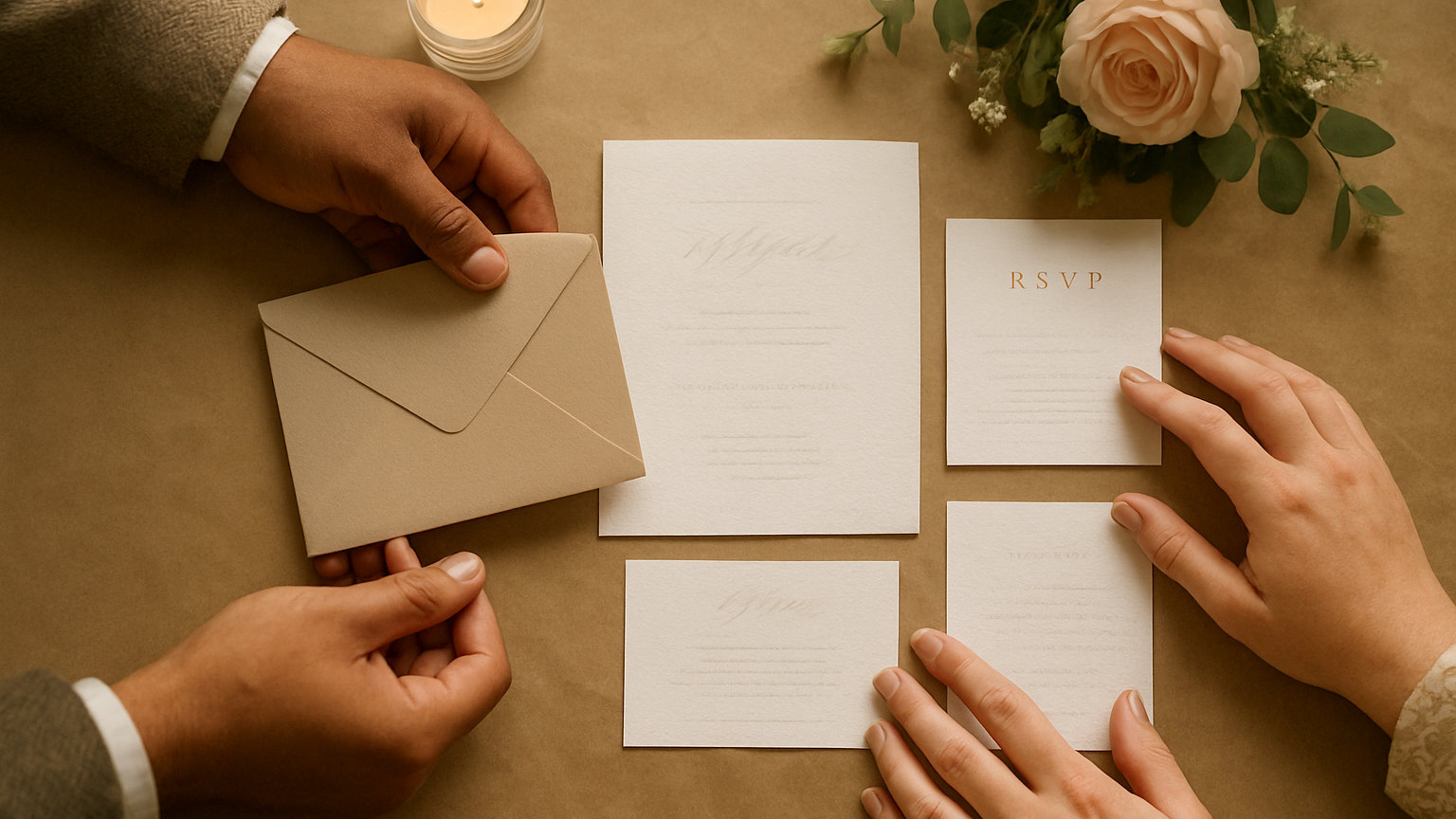
Traditional invitation wording follows a fixed structure built around who is hosting, which in practice means who is paying. Very few weddings now fit that model neatly, and adapting it is straightforward once the structure is clear.
What is the traditional structure?
A host line naming who is inviting, a request line, the names of the couple, the date and time, the venue, and a line about the reception.
Traditionally the bride parents host, so the wording begins with their names and requests the pleasure of the company of the guest.
What does the request line mean?
Request the pleasure of your company is the conventional phrasing for a civil ceremony or a secular setting. Request the honour of your presence is traditionally used for a religious ceremony in a place of worship.
Neither is compulsory. A great many invitations now simply say we are getting married and would love you to be there.
What if the couple is hosting?
Begin with your own names, or use a phrase such as together with their families. Both are common and neither raises an eyebrow.
Together with their families is the most useful modern formula, since it acknowledges everybody without specifying who paid for what.
How do you handle divorced parents?
List them on separate lines, with the mother first, and without the word and joining them. That is the conventional solution and it works.
Where a parent has remarried, use their current name. Where the relationship is difficult, together with their families avoids the question entirely.
What if a parent has died?
There is no fixed convention and several approaches are used. Some name the surviving parent only, some include the late parent with a phrase such as the late, and some use a general family line.
Any is correct. Choose whichever feels right and do not let etiquette override what you want, since this is a personal matter rather than a formal one.
How should names be written?
Traditionally in full with titles, and increasingly as people are actually known. Both are acceptable and consistency matters more than which you choose.
Write your own names as you want them to appear. There is no requirement to use a middle name or a title you never use.
How formal should the language be?
Match the wedding. Formal wording for a formal wedding, and something warmer for a relaxed one. An ornate invitation to a barbecue in a field reads oddly.
The invitation sets an expectation, so it is worth having it match the day guests will actually attend.
What about the date and time?
Traditionally written out in full, such as Saturday the fourteenth of June, two thousand and twenty six. Numerals are now entirely common and considerably easier to read.
Whichever you use, include the day of the week. It is the detail guests check most and it prevents diary errors.
What about second marriages?
No special wording is required and the older conventions around it have largely disappeared. Use whatever suits you.
Children from previous relationships are frequently included in the host line, which is a warm touch and entirely conventional now.
What is the practical advice?
Write it as you would say it, then check that the five essential facts are present. Etiquette matters far less than clarity and warmth.
Have somebody outside the wedding read it. They will spot the ambiguity that you cannot, because you already know what you meant.
Does anybody actually judge it?
Almost nobody. Guests read an invitation to find out when and where, and the wording registers only if it is confusing.
That is worth remembering if the etiquette question is causing difficulty. Clarity and warmth matter and formal correctness does not.
What should you check before printing?
Every name spelled correctly, the date matched against the day of the week, and the venue address exactly as the venue writes it. Those three carry most of the errors.


