
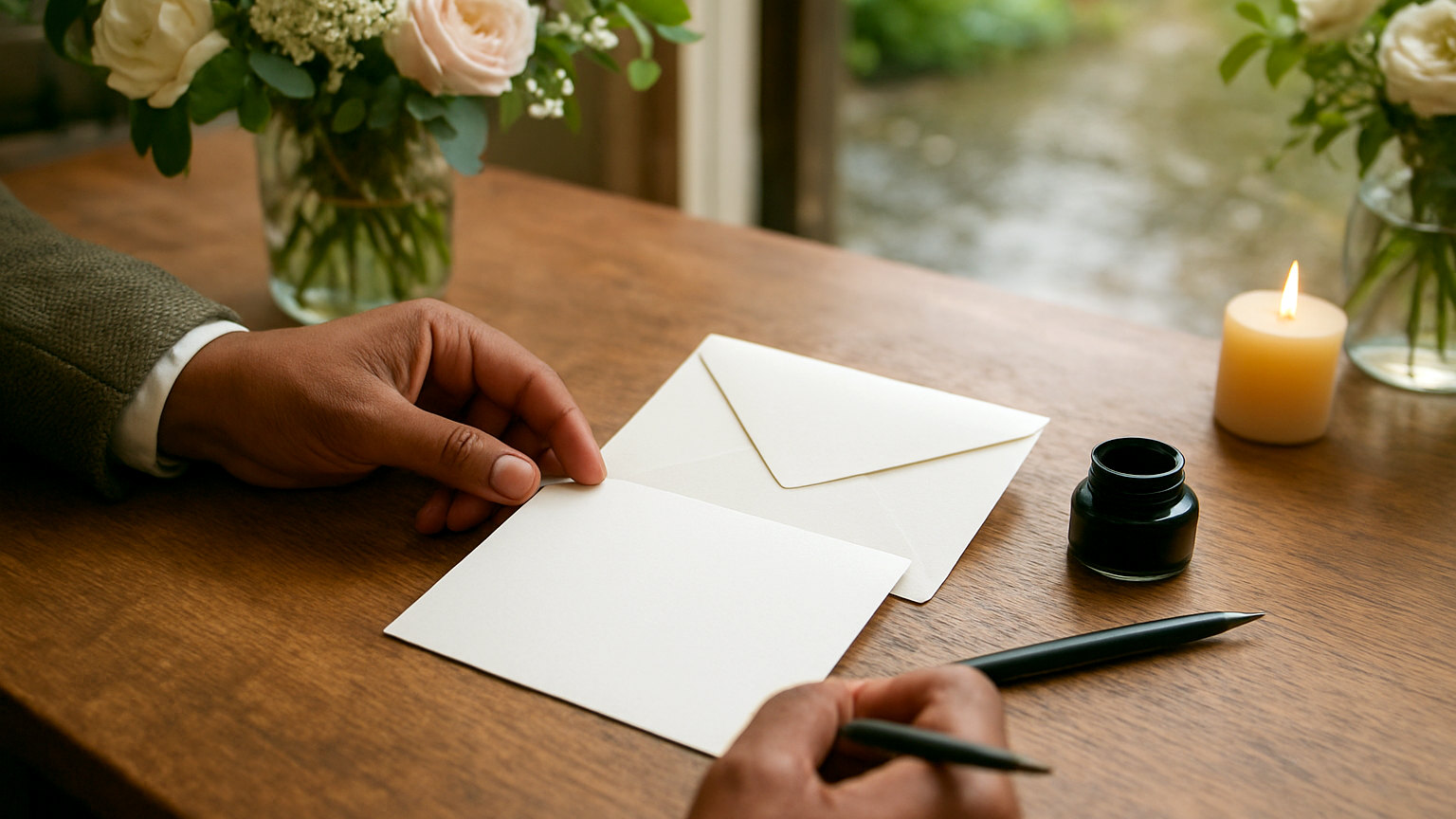
The envelope does more work than people realise. Naming exactly who is invited on the outside answers the plus one and children questions before the invitation is even opened, which prevents most of the awkwardness around both.
Why does the naming matter?
Because it defines the invitation. An envelope addressed to two named people invites two named people, and one addressed to a family invites the family.
Ambiguity here is the single most common cause of a guest arriving with somebody you had not counted.
How do you handle a plus one?
Name them if you know who they are, which is more welcoming and unambiguous. If you do not, address it to the guest and guest.
Where no plus one is offered, name only the person invited. That is the conventional way of saying it and it is understood.
How do you handle children?
Name the children if they are invited, and name only the adults if they are not. Addressing to a family name invites the family.
Where children are not invited at all, that should have been communicated before the invitation rather than through it, since parents need notice to arrange childcare.
What about titles?
Traditionally full titles and surnames, and increasingly people are addressed as they are actually known. Both are acceptable.
Consistency matters more than which you choose. Using formal titles for some households and first names for others reads as an oversight.
Should you use two envelopes?
An outer envelope for posting and an inner one naming the guests is an American convention and is rarely used in Britain.
One envelope, clearly addressed, does the same job. The second is an additional cost and an additional item to assemble.
Is calligraphy worth it?
It looks beautiful and it costs meaningfully more, either as a service or in your own time. It is a genuine indulgence rather than a functional improvement.
Neatly handwritten envelopes read as personal and cost nothing. Printed labels are the least warm option and are entirely acceptable.
How long does addressing take?
An evening for a hundred households, longer if you are being careful about handwriting. It is consistently underestimated.
Set aside a single session rather than doing thirty at a time, and check every address against the guest list as you go.
What about the postage?
Weigh a complete finished invitation before buying stamps. Square envelopes and anything exceeding standard thickness cost noticeably more to post.
That difference applies to every one of them, so it is worth establishing before the print run is ordered rather than after.
Should you post them all together?
Yes, on the same day where possible, including any evening invitations. Guests compare notes almost immediately and a gap between batches is noticed.
Take them to a post office rather than a postbox for anything unusual in size, so they can be weighed and correctly stamped.
What should you check first?
Every address against a current source rather than from memory or an old list. People move, and an invitation returned undelivered wastes a fortnight.
Collect addresses when you send save the dates, or ask on a website form. Doing it at the invitation stage is how the send date slips.
Should you use a return address?
Worth including, so undelivered invitations come back rather than disappearing. A printed label or a stamp on the flap is sufficient.
It also tells you promptly which addresses are wrong, which is information you want at three months rather than at three weeks.
When should you collect addresses?
At the save the date stage or through a website form, well before the invitations. Collecting them at the invitation stage is how the send date slips by a fortnight.
Name exactly who is invited, weigh one before buying stamps, and post them all on the same day. Three habits that prevent most invitation problems.
How long does it take?
An evening for a hundred households, and longer than that if the handwriting matters to you. Set aside one session rather than doing thirty at a time.


