
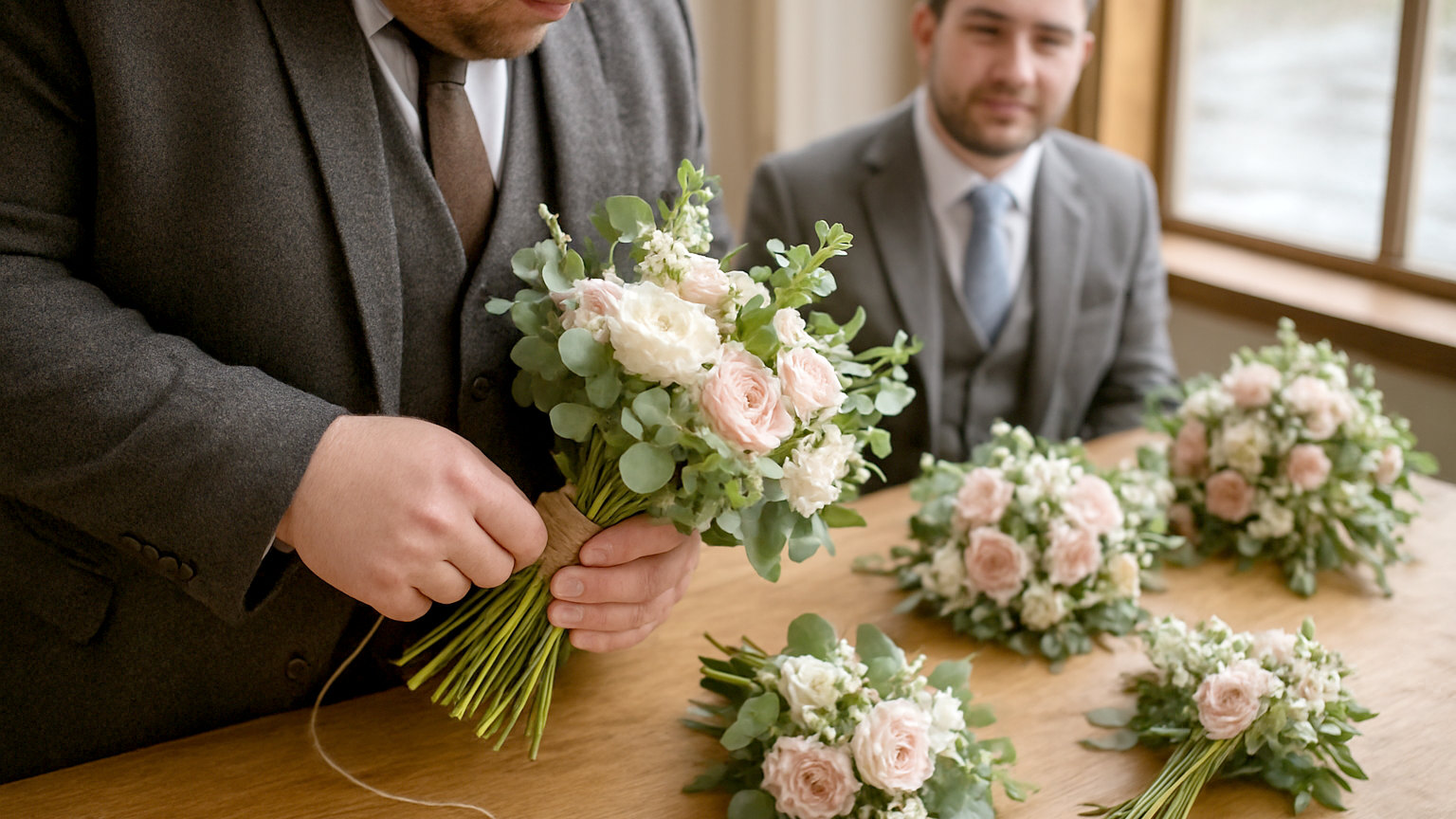
Bouquet shapes have names that get used in florist meetings and are rarely explained. Each behaves differently in photographs and in the hand, and the difference in weight is larger than people expect.
What is a hand tied bouquet?
Stems gathered and bound at a single point with the flowers arranged loosely above. It is the most common style and the most versatile.
It suits almost every wedding, ranges from tight and formal to loose and wild, and it can be put straight into a vase afterwards.
What is a posy?
A small, round, compact bouquet, neat rather than loose. Traditional, tidy in photographs and light to carry.
It suits smaller weddings, register office ceremonies and anybody who does not want something large in front of the dress.
What is a cascade?
Also called a shower or teardrop, with flowers falling downward from the hand in a defined shape. The most dramatic option and the most structured.
It is heavy, since it requires mechanics to hold the shape, and it obscures more of the dress. Both are worth knowing before choosing one.
What is a sheaf?
Long stems carried along one arm rather than in front, sometimes called a presentation bouquet. It has an elegant line and photographs distinctively.
It is awkward to hold for long periods and difficult to put down and pick up, which matters over a long ceremony.
What about a single stem?
Increasingly common and very effective, particularly at small or informal weddings. One striking flower or a few stems tied simply.
It costs almost nothing, it never obscures the dress and it photographs cleanly. It is the most underrated option available.
What is a pomander?
A ball of flowers carried by a ribbon loop, usually given to younger attendants. Practical for children since it does not need to be held carefully.
It is easy to carry and easy to put down, which is the main argument for it at that age.
How much does weight matter?
More than people anticipate. You will carry it through the ceremony, the photographs and the receiving line, which is longer than it sounds.
Ask to hold a mock up or something similar at the meeting. A large cascade is genuinely heavy and it is better to discover that in a shop.
How does size work in photographs?
A bouquet that looks generous in the hand can look small in a full length photograph, and one that looks right in a photograph can dominate the dress.
Scale it to you rather than to an image. A florist will hold examples against you at the meeting, which settles it immediately.
What about the binding?
Ribbon, fabric, twine or exposed stems, and it is an easy place for something sentimental. A piece of lace or a fabric from a relative garment is common.
Tell the florist in advance so they can build it in properly rather than adding it at the last moment.
Which should you choose?
Whatever suits the dress and the setting, and whichever you can comfortably carry. A hand tied bouquet in a size scaled to you works for the overwhelming majority of weddings.
If the dress is heavily detailed, smaller is generally better, since a large bouquet covers exactly the part of the dress you chose it for.
How do you decide?
By the dress and by what you can carry comfortably. A florist will hold examples against you at the meeting, which settles it faster than any amount of research.
Does the shape date?
Somewhat. Very structured cascades and tightly wired posies read as belonging to particular decades, and a loosely gathered hand tied bouquet tends to look right in photographs for longer.
Can you change it during the day?
Some couples carry a smaller version for the evening, or none at all once the photographs are done. There is no obligation to hold it all day and a great many do not.


