
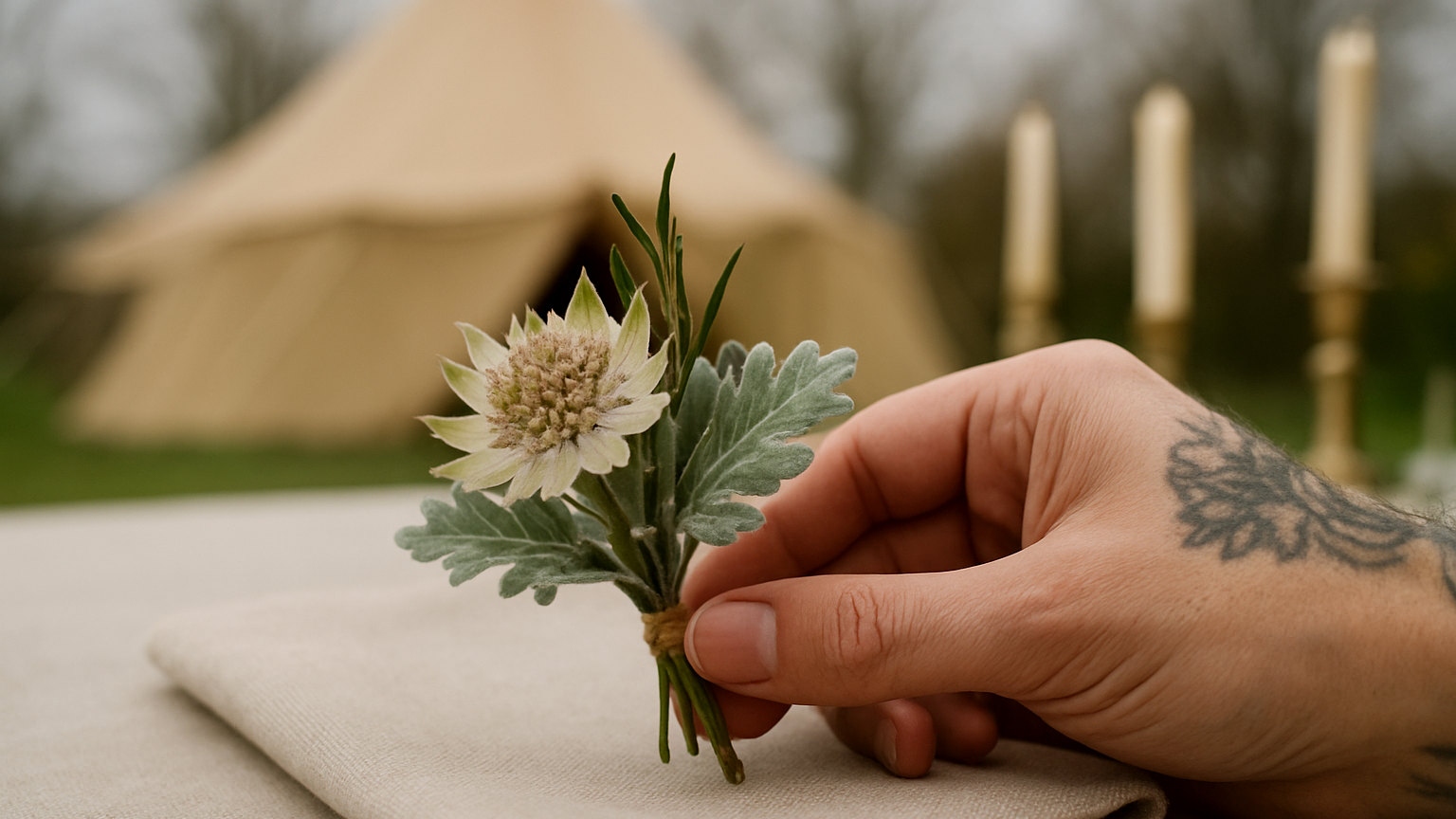
Bridesmaid flowers are conventionally smaller versions of the bridal bouquet, and there is more latitude here than most couples use. They are also among the easier places to reduce a floral budget without anybody noticing.
What is the convention?
Smaller posies or hand tied bouquets echoing the bridal bouquet, usually in the same palette with fewer stems.
The bridal bouquet is normally larger and more elaborate so it reads as distinct in photographs, which is worth preserving whatever else you do.
What size should they be?
Noticeably smaller than the bridal bouquet, and scaled to whoever is carrying it. A large bouquet in the hands of a small adult or a child looks wrong and is difficult to hold.
Ask the florist to show examples against each person if they are at the meeting, or give approximate heights.
Should they all be identical?
Not necessarily, and variation frequently looks better in photographs. Different combinations from the same palette reads as considered rather than uniform.
It also lets a florist use what is good that week rather than repeating one recipe five times.
What are the cheaper alternatives?
A single stem each, which costs very little and photographs cleanly. Three or four stems tied with ribbon. A small posy rather than a bouquet.
All of these look deliberate rather than economical, particularly if the bridal bouquet is generous by contrast.
What works for children?
A pomander on a ribbon loop, a small basket, or a single flower. All are easier to carry and easier to put down, which matters at that age.
Petals for scattering are common and need checking with the venue, since some prohibit them indoors and outdoors.
What about no flowers at all?
Entirely reasonable and increasingly common. Bridesmaids with nothing to carry have free hands to help with the dress, which is genuinely useful.
Alternatives include a small bag, a fan in summer, a lantern for a winter evening, or simply nothing.
What about hair flowers?
A common substitute and a cheaper one. A few stems in the hair costs a fraction of a bouquet and photographs well.
Tell the hair stylist in advance and make sure the florist supplies them wired and prepared rather than as cut stems.
Who holds the bridal bouquet?
Usually the chief bridesmaid during the ceremony, which is worth telling them in advance so it is not a surprise at the front.
It needs somewhere to go afterwards too, ideally water. A bouquet on a warm table for six hours does not last.
What do they cost?
Bridal and bridesmaid bouquets together commonly account for a meaningful part of a floral budget, and the bridesmaid share scales directly with the number of them.
Five bridesmaids is five bouquets, which is where this line grows. Reducing the size rather than the number is the usual saving.
What happens afterwards?
They are frequently left behind, which is a waste. Tell bridesmaids to take them home, or arrange for them to be used on tables during the reception.
Moving bouquets into vases on the top table during the drinks is common, costs nothing and puts flowers where guests will actually see them.
Should they choose?
Where the bouquets differ, involving them is generous and takes very little effort. Where everything matches, it is simpler to decide it yourself.
Either way, tell them what they will be carrying before the morning. It is a small thing and it avoids surprise at a moment when there is no time.
What should the florist know?
The number, the approximate heights of the people carrying them and whether any are children. All three affect the scale and the construction.
Is there a saving here?
A real one. Reducing the size rather than removing them entirely keeps the look and cuts the cost, and five smaller posies is a meaningfully different figure from five bouquets.
Whatever you choose, tell them beforehand and tell them to take it home. Both take a sentence and both are routinely forgotten.


