
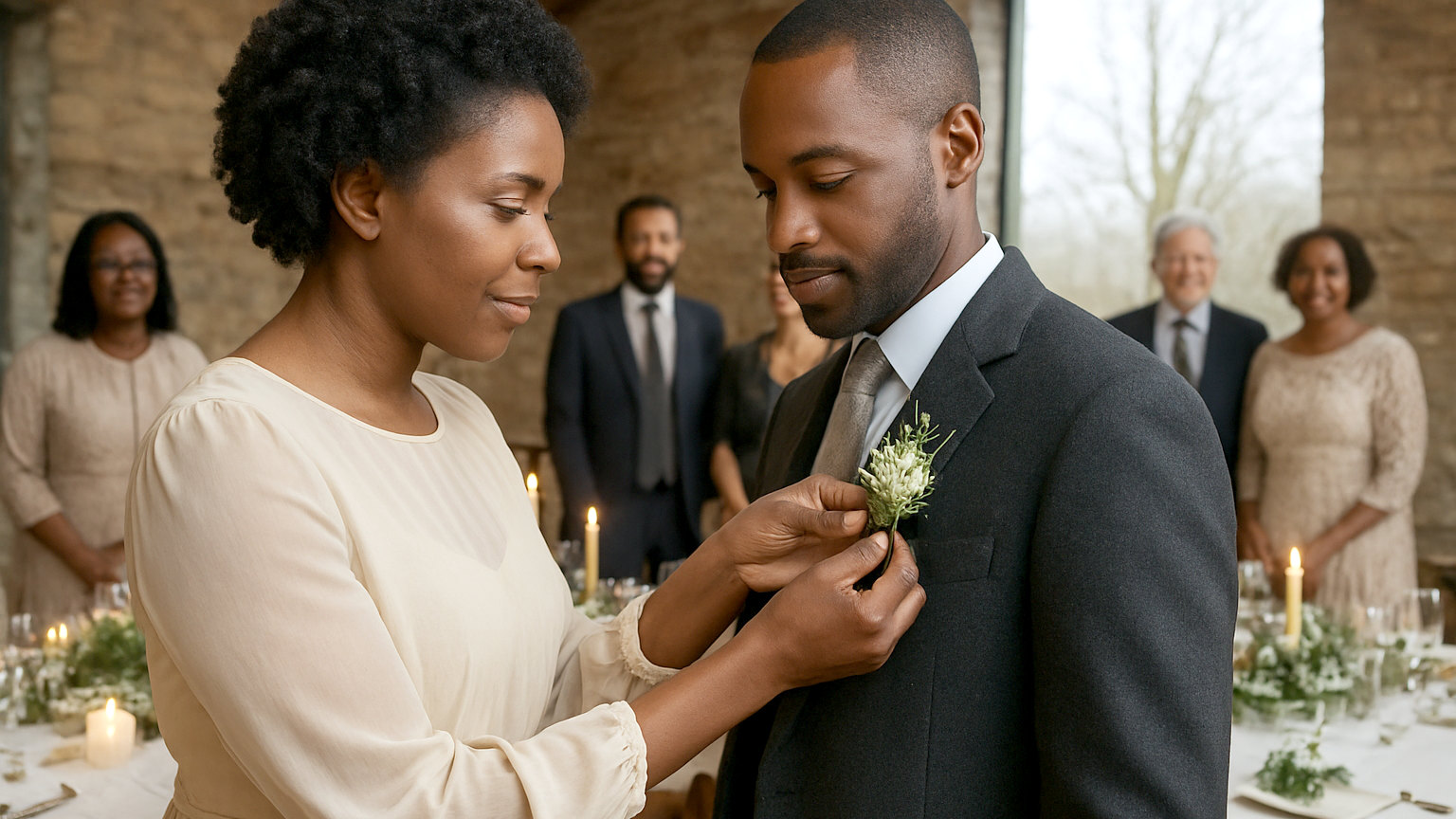
Buttonholes are small, inexpensive and consistently mishandled on the morning of a wedding. They arrive in a box, nobody has been told who gets one, and half of them end up pinned badly or not at all.
What is a buttonhole?
A small floral arrangement worn on the left lapel, also called a boutonniere. Traditionally a single flower with a little foliage, though modern versions are frequently larger.
A corsage is the equivalent worn by women, either pinned or on a wrist band, and is commonly given to mothers and grandmothers.
Who traditionally wears one?
The groom, the best man, the ushers and both fathers, with corsages for both mothers. Beyond that it is entirely a matter of choice.
Many couples extend it to grandparents, readers, anybody with a role in the ceremony and occasionally the whole wedding party.
How many should you order?
Write the list by name rather than by number, since it is the most reliable way to avoid somebody being missed.
Order two or three spares. They get dropped, crushed and lost, and a spare box costs very little relative to the awkwardness of somebody going without.
How are they fixed?
Pinned through the lapel from behind, with the pin passing through the fabric and back, so the head is hidden. Not pushed straight through from the front.
They sit on the left lapel, stems downward. Magnetic fixings are an alternative and are gentler on delicate fabric.
Who does the pinning?
Somebody nominated in advance, since it is fiddly and there are usually eight or ten of them. It takes fifteen minutes and it always happens at the busiest moment.
Ask the florist to include pins and to show one person how before leaving. A phone video is genuinely useful.
When do they arrive?
Usually delivered to wherever the wedding party is getting ready, which may be a different address from the venue. Tell the florist explicitly.
Keep them cool and out of direct sun until needed. A box of buttonholes on a sunny windowsill for three hours does not survive.
What flowers work?
Something sturdy, since a buttonhole is knocked, hugged and sat on all day. Roses, spray roses, thistles, waxflower and berries all hold up well.
Very delicate flowers wilt visibly by the afternoon. Ask the florist what lasts, since they know exactly which ones do not.
Should they match the bouquet?
Loosely, and they usually pick up one element from it rather than replicating it. That reads as deliberate and costs less.
Distinguishing the groom slightly, with a different flower or a larger buttonhole, is common and helps in photographs.
What do they cost?
A few pounds each, which makes them among the cheapest flowers at a wedding and among the most photographed relative to price.
They appear in every portrait of the wedding party, which is a strong argument for ordering enough and ordering them well.
What goes wrong?
Nobody knows who gets one, nobody has pins, and they are still in the box at the ceremony. All three are prevented by a named list and one person given the job.
Put it on the morning running order with a name against it, alongside everything else that has to happen before leaving.
What should the florist be told?
The number, the delivery address for the morning, and whether anybody has an allergy or a strong preference. Three details, and the last one is rarely mentioned.
Are they necessary?
Not at all, and a growing number of weddings skip them. Where the wedding is informal or the party is small, nobody notices their absence.
What is the most useful preparation?
A named list, one person given the job, pins included in the box and two spares. Four small things that between them prevent every common buttonhole problem.
They cost a few pounds each and appear in every group photograph, which makes them among the best value flowers at any wedding.


