
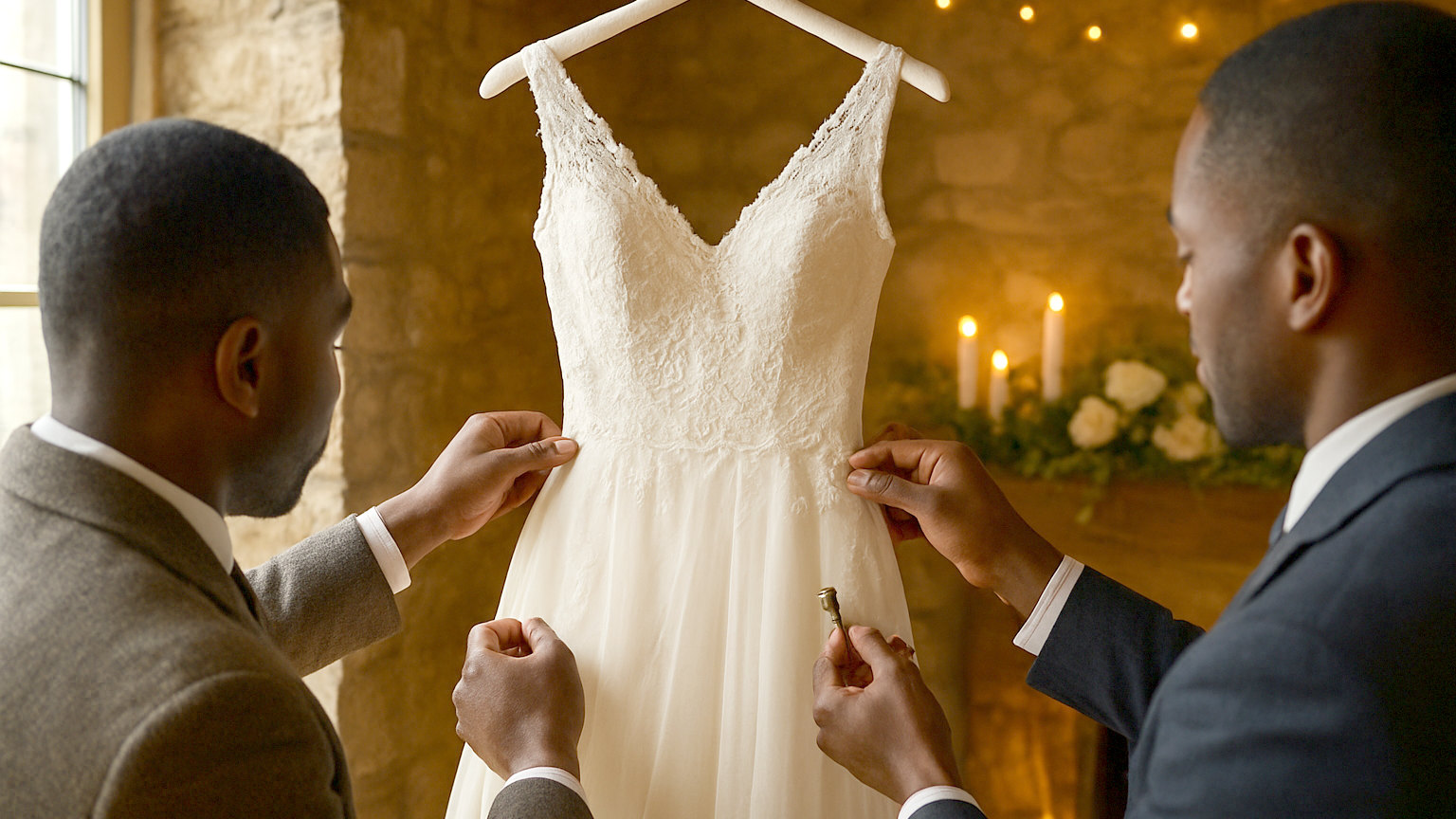
Alterations are what turn an ordered dress into one that fits you, and they are the most commonly forgotten line in a wedding clothing budget. What shows in photographs is fit, and fit is a function of this work rather than of the original price.
How many fittings are there?
Usually two or three across six to ten weeks, starting around eight weeks before the wedding. A complex dress or one needing substantial work may need more.
The first fitting establishes what needs doing, the second checks the work, and the final one is a last adjustment shortly before the day.
What is usually altered?
The side seams and bodice to bring the dress in, the straps or shoulders to set the height, and the hem to the correct length for your shoes.
A bustle is added to almost every dress with a train, which is the arrangement of loops and buttons that lifts the train for the evening.
Why does the hem matter so much?
Because it determines whether you can walk without stepping on the dress, which is the most common practical complaint at a wedding.
Bring the actual shoes you will wear to the first fitting rather than a similar pair. Two centimetres of heel changes the hem entirely and it cannot be adjusted afterwards.
What about underwear?
Bring it to the first fitting too, for the same reason. Underwear changes the shape of the bodice and the fit is set around whatever you are wearing on the day.
Boutiques will advise what works with the dress. Some dresses have built in support and others need something specific.
What does a bustle do?
Lifts and secures the train so you can move and dance in the evening. It is arranged during the alterations and is not something a dress arrives with.
Ask somebody to learn it at the final fitting, since somebody has to do it on the day and it takes practice. A phone video of the seamstress doing it is genuinely useful.
What cannot be altered?
Letting out is limited by the seam allowance, so a dress cannot be made substantially larger. Changing the fundamental shape is also generally not possible.
Adding sleeves, changing a neckline or removing detail is sometimes possible depending on the construction. Ask before assuming either way.
Who does the work?
Either the boutique in house seamstress or an independent one you arrange yourself. Both are common and the boutique will tell you which applies.
If you are using an independent, choose somebody who works on bridal specifically. It is a different discipline from ordinary alterations, particularly with lace and structured bodices.
When should it be booked?
At the point of ordering the dress rather than when it arrives. Boutique alteration diaries fill during summer just as the fitting rooms do.
Discovering in June that the seamstress has no slots until August is a genuinely stressful way to find out, and it is entirely avoidable with one question.
What does it cost?
Commonly several hundred pounds and it is charged separately from the dress in almost every case. A dress recorded in the budget at its purchase price is short by that amount.
It is also the last place to economise. A well altered inexpensive dress photographs better than an unaltered expensive one, every time.
What should you take to each fitting?
The shoes, the underwear, and anybody who will be helping you dress on the day. All three affect either the fit or what happens on the morning.
Take the veil and any accessories to the final one, so the whole look is checked together rather than in pieces.
When is the final fitting?
Usually one to two weeks before the wedding, which is late enough to be accurate and early enough to fix anything.
Budget for it from the start and book it at the point of order. Those two steps prevent both of the problems this work usually causes.


