
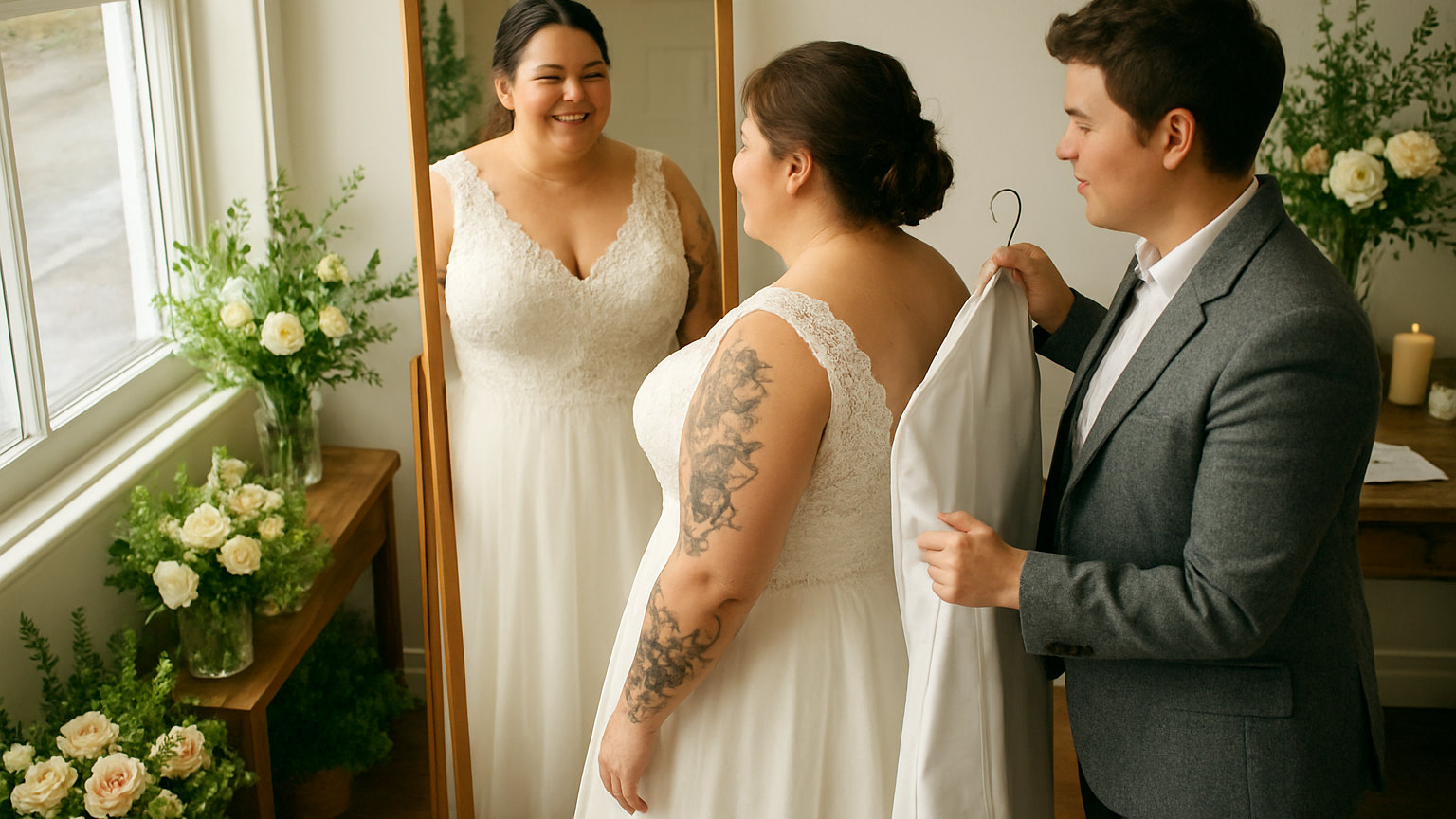
Most damage to wedding dresses happens in the weeks between collection and the wedding rather than on the day itself. Storage, transport and a small emergency kit cover almost all of it.
How should it be stored?
Hanging, in a breathable garment bag, somewhere cool, dry and dark. Not in plastic, which traps moisture, and not in a loft or a damp room.
Hang it by the internal loops rather than the shoulders if it has them, since a heavy dress hung by the straps stretches over weeks.
Where should it hang?
Somewhere out of daylight, since sun fades fabric surprisingly quickly, and somewhere it will not be knocked. A spare wardrobe is ideal and the back of a door is not.
If you are hiding it, be careful that the hiding place is not damp. A garage or a shed is a poor idea for several months.
How do you transport it?
Hanging where possible, in the bag, laid across a back seat rather than folded in a boot. For a long journey, hang it from a grab handle.
Take it to the venue yourself or give it to somebody with one job. It is the single item that cannot be replaced on the morning.
Does it need steaming?
Usually, and boutiques often do this before collection or offer it. Creases from storage and transport are normal and steaming removes them.
Ask before doing it yourself, since some fabrics and any beading can be damaged by direct heat. A professional steam is inexpensive and safer.
What should be in the emergency kit?
Safety pins, a small sewing kit in matching thread, double sided tape, plasters, and a stain remover suitable for the fabric.
Test any stain product on an inside seam beforehand rather than using it for the first time on a mark. Some remove the mark and leave a worse one.
What about marks on the day?
Most are dealt with by blotting rather than rubbing, and a great many become invisible once the dress moves. Do not attack a mark with water on silk.
Hems get dirty at almost every wedding, particularly outdoors, and it is worth accepting rather than fighting. It is invisible in photographs and cleans afterwards.
Who helps you into it?
Somebody who has seen it done, ideally at a fitting. Bridal dresses cannot generally be put on alone and the process is not obvious.
The same applies to the bustle. Have somebody learn it at the final fitting and take a video, since it has to be done in the evening by somebody who may have had a drink.
What about the morning?
Get dressed last, after hair and makeup, and after anybody with lipstick has left the immediate area. Cover your face when the dress goes over your head.
Eat before you put it on rather than after. It sounds obvious and it is the most common cause of a mark before the ceremony.
What should happen at the end of the night?
Somebody takes it, hangs it and brings it home. Assign that in advance rather than leaving it draped over a chair in a hotel room.
Do not put a damp or marked dress into a sealed bag for weeks. Air it, then deal with cleaning when you can.
When should you collect it?
Usually at the final fitting, one to two weeks before the wedding. Earlier collection means longer at home, which is where most damage happens.
Some boutiques will hold it until the last few days if storage at home is difficult. Ask, since it is frequently offered.
What is the most common damage?
Marks on the hem from outdoor ground and makeup on the bodice from dressing. The first is unavoidable and cleans, and the second is prevented by dressing last and covering your face.
What should you plan for?
Somebody helping you dress, somebody who can do the bustle, and a small kit. Those three cover almost everything that goes wrong with a dress on a wedding day.


