
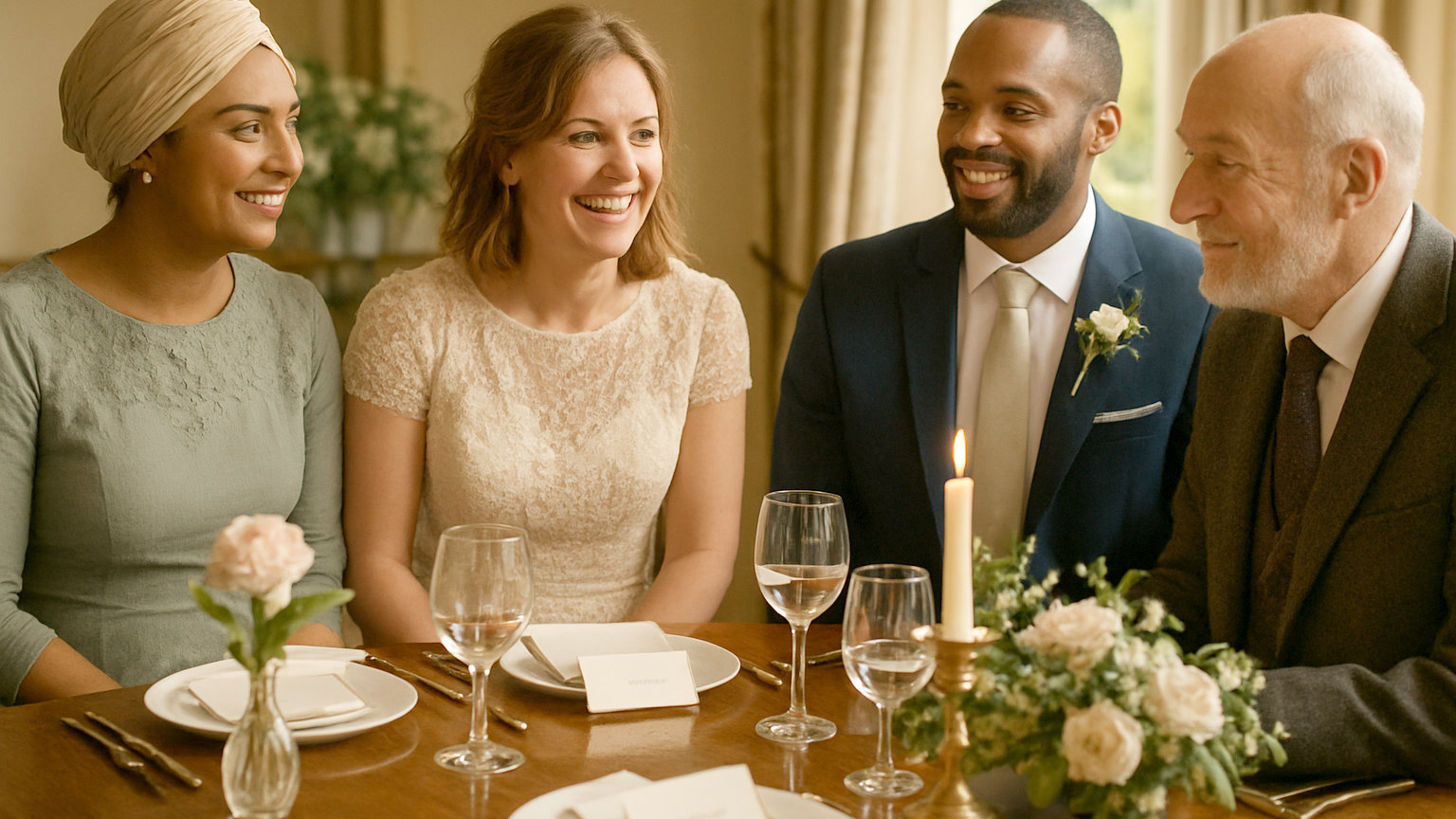
A wedding table has considerably less spare surface than most plans assume. Once the place settings, the glassware and the food are on it, what remains for decoration is a strip down the middle and very little else.
What has to be on the table?
A place setting for each guest, which means a plate, cutlery, two or three glasses and a napkin. Then water, wine and anything the caterer needs to put down.
At ten around a six foot round, that fills most of the surface before a single decorative item is added.
What is genuinely optional?
The centrepiece, candles, a runner, favours, table numbers and menus. All of it is decorative and all of it competes for the same remaining space.
Choosing three of those rather than six is what separates a table that looks considered from one that looks crowded.
How much space is actually left?
A strip down the centre of a long table, or a circle in the middle of a round one, and not much more. Anything at a place setting reduces the space a guest has to eat.
Ask the venue or the caterer how they lay a table for your numbers. They will tell you what fits, since they do it every weekend.
What causes the most problems?
Too many separate items. A centrepiece, four candles, scattered petals, a favour, a menu, a place card and a table number is seven things per table.
Guests move whatever is in their way, so a cluttered table is dismantled within ten minutes of sitting down.
What do the staff need?
Room to serve and clear from behind and between guests. A tall or wide centrepiece can genuinely obstruct service, which slows the meal.
Ask the venue whether anything you are planning causes them difficulty. It is a fair question and they will answer honestly.
What do guests need?
To see and hear each other across the table, and somewhere to put a drink down. Both are affected directly by what is in the middle.
That is the practical argument for a centrepiece that is either low or raised on a stem rather than a solid mass at eye level.
What should come first?
Whatever the guests interact with. Good glassware, a decent napkin and a clean well pressed cloth do more for a table than anything decorative on top of it.
That is also where the venue can help, since many hold better linen and glassware than the standard set and will supply it on request.
What is worth spending on?
The table, because guests look at it for two hours. It is the highest value styling at any wedding by that measure alone.
Within it, one good centrepiece beats several small ones, and candles do more per pound than anything else.
What can be dropped entirely?
Favours, table numbers where tables are named on the plan, menus where the food is announced, and anything scattered across the cloth.
None of them is missed, and each removes an item competing for space.
What is the practical test?
Lay one table at home with everything you plan, including the plates and glasses, and sit at it. Anything you would move is something to leave out.
It takes twenty minutes and it is the single most useful exercise in table styling.
How does table size change it?
Considerably. A six foot round seating ten leaves very little spare surface, and the same table seating eight leaves noticeably more.
Ask what size tables the venue uses and how many they seat. Those two figures determine what is realistic before anything is chosen.
Who lays it out?
The venue in almost every case, working from whatever you provide and a plan. Give them a photograph of one finished table rather than a description.
That single image answers every question they would otherwise ask on the morning, when you are unavailable.


