
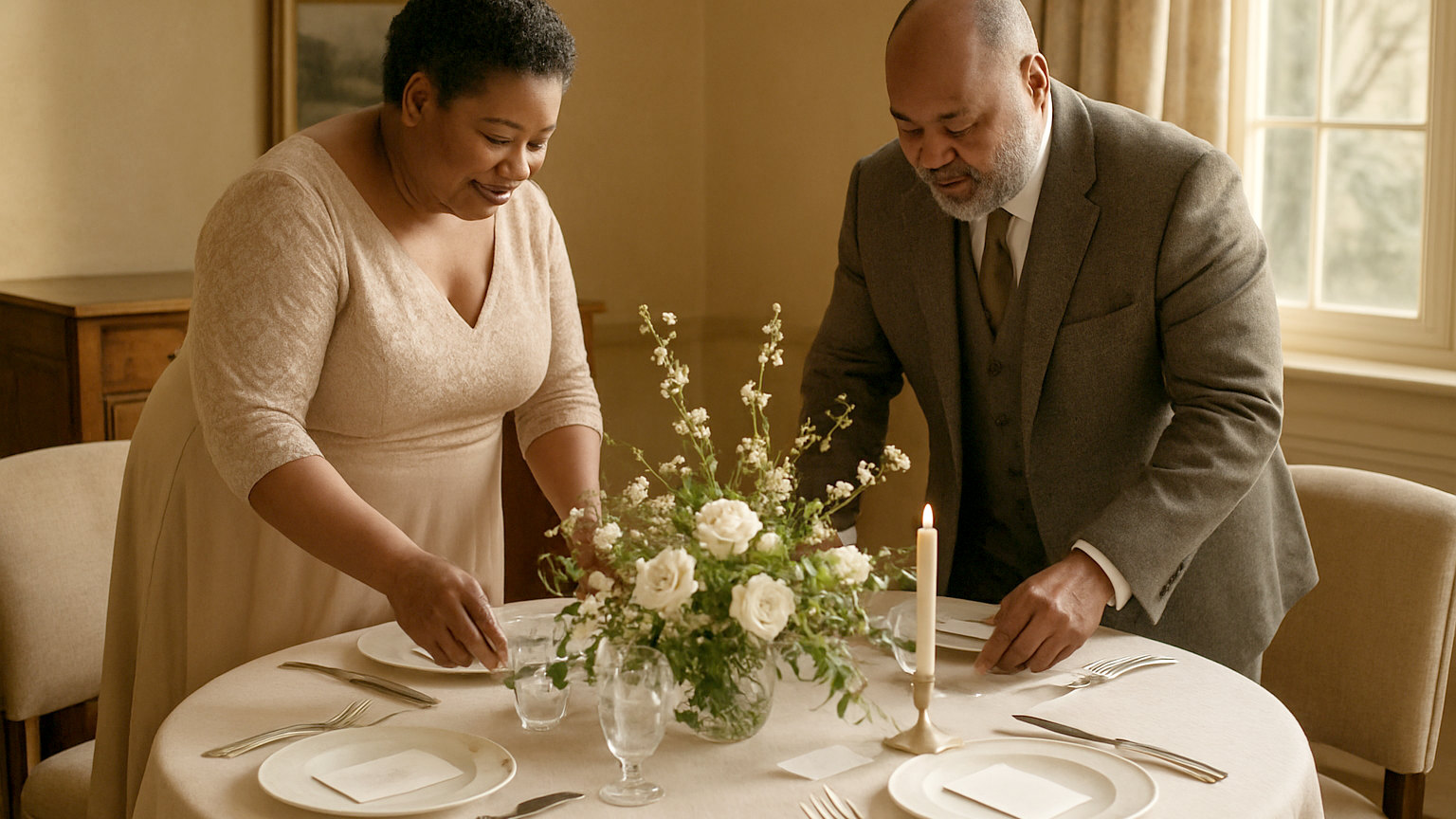
Height is the single decision that determines whether guests can talk to each other across a table. There are two ranges that work and one in the middle that does not, and the middle is where most centrepieces end up.
What is the problem with the middle?
An arrangement that sits at roughly seated eye level blocks the view across the table entirely. Guests then either lean around it or talk only to the people beside them.
It is the most common table styling error and it is completely avoidable, since the fix costs nothing.
What is the low option?
Anything sitting comfortably below the line of sight of a seated person, which in practice means a compact arrangement rather than a tall one.
It keeps the table open, works with any table shape and is the safer of the two ranges. It also uses fewer stems and costs less.
What is the tall option?
An arrangement raised on a narrow stem or a tall vessel, with the flowers well above head height so people see beneath it.
It creates height and drama in a room with a high ceiling, and it works only if the stem is genuinely narrow. A wide column at that height blocks as effectively as a low mass.
How do you test it?
Sit down at a table with the proposed arrangement in place and see whether you can make eye contact with the person opposite.
Ask the florist for a mock up if the arrangement is a significant part of the budget. Most will do one and it settles the question immediately.
Does the table size change it?
Considerably. A wider table gives more distance between guests and tolerates a larger arrangement, and a narrow long table tolerates very little.
Long tables generally suit low runners rather than tall pieces, since the sightline runs along the table as well as across it.
Can you mix heights?
Across a room, yes, and it looks good. Some tables tall and some low creates variation in a large room and avoids uniformity.
On a single table, a tall piece with low elements around it works well, provided the tall one is on a narrow stem.
What about candles?
Tapers sit above eye level on a narrow stem, which is exactly why they work. Pillar candles and tealights sit below it.
Both are fine and a mixture of the two at different heights is one of the most effective and least expensive table treatments available.
Does the ceiling matter?
Tall arrangements need the room to carry them. In a low ceilinged space they feel cramped, and in a barn or a marquee they fill vertical space that would otherwise be empty.
Look up at the viewing. The room usually indicates which range suits it.
What do photographers prefer?
Low, generally, since tall arrangements obscure guests in wider shots of the room and in photographs taken during the speeches.
Ask yours, since it costs nothing and they will have a clear preference based on your venue.
What is the practical rule?
Either clearly below eye level or clearly above it, and never between. That single decision solves most of what goes wrong with table centrepieces.
What about mixed table shapes?
Keep the height range consistent even where the arrangements differ, since a room with some tables blocked and others open looks inconsistent rather than varied.
Vary the contents and hold the height. That reads as deliberate and costs nothing extra.
What is the simplest safe choice?
Low. It works on every table shape, in every room, never blocks anybody and costs less than a tall arrangement of the same quality.
Does anybody actually complain?
Not out loud, and they lean around it all evening, which does the same thing more quietly. Sitting at a mocked up table for two minutes catches it in advance.
Clearly low or clearly tall on a narrow stem, and never in between. That is the whole decision.


