
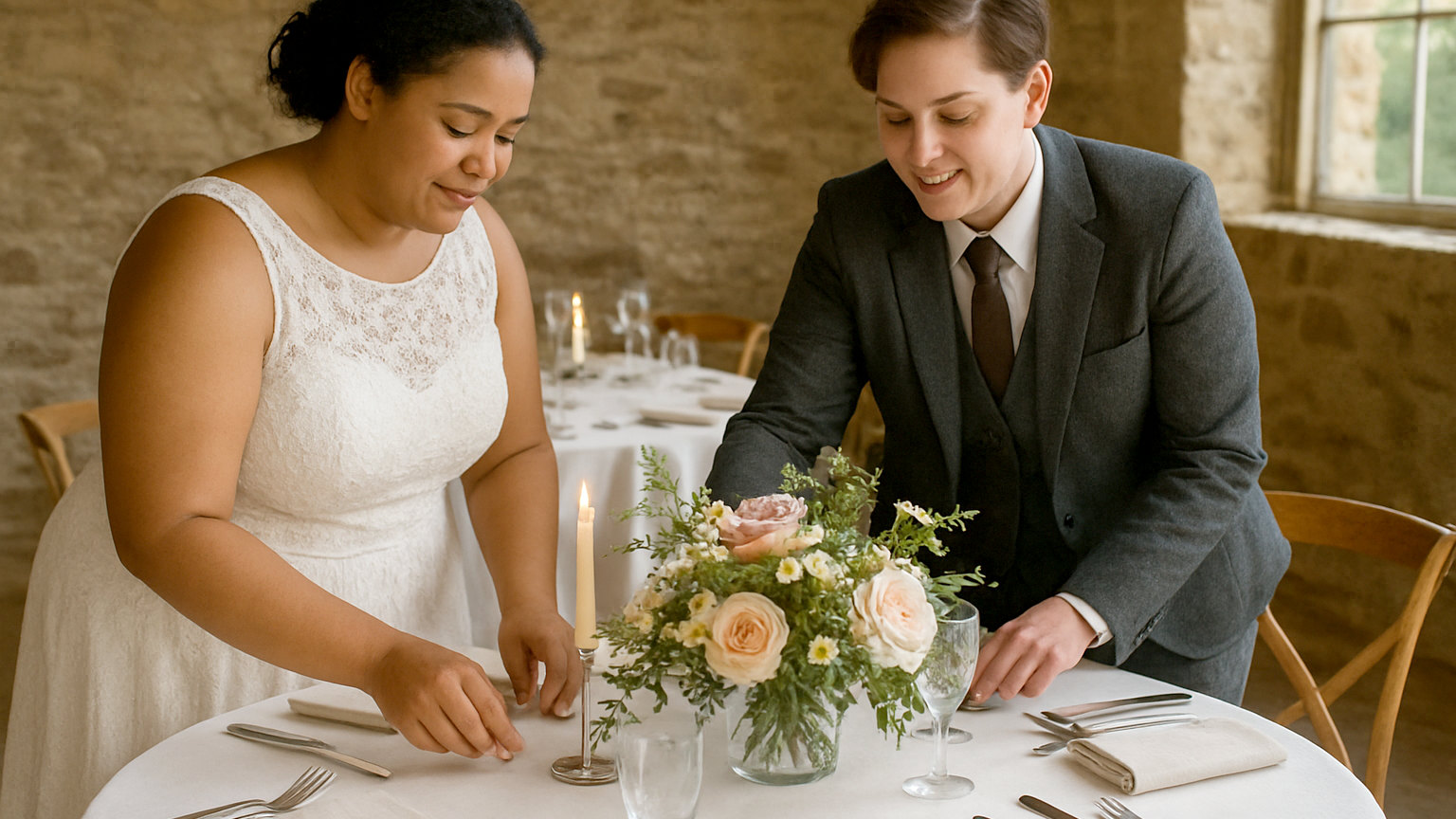
The centrepiece is the one decorative item guests look at for two hours, which makes it the highest value styling at a wedding. It also sits directly between people trying to talk to each other, which is the constraint that shapes everything.
What are the options?
A floral arrangement, a group of candles, foliage laid along the table, potted plants, a lantern, or a combination. All work and they cost very differently.
Candles and foliage are the cheapest by a wide margin and are frequently the most effective, particularly in the evening.
What is the main constraint?
Sightlines. Anything solid at seated eye level blocks conversation across the table, which guests notice within minutes.
The usual solution is to go either low, below the line of sight, or high on a narrow stem so people can see beneath it.
Should every table match?
Not necessarily. Varying the arrangements across tables looks deliberate and lets a florist use what is good that week rather than repeating one recipe fifteen times.
Keeping them within one palette and one rough height is enough to read as coherent.
How many pieces per table?
One larger arrangement generally beats three small ones on a round table, and a run of smaller pieces suits a long one.
The exception is bud vases, where a cluster of three or five small vessels with a few stems each is both cheap and effective.
What about candles instead?
A group of candles at varying heights is one of the best value centrepieces available, particularly for an evening or winter wedding.
Check the venue policy first, since naked flames are prohibited at many and others require them contained in glass.
What does it cost?
Floral centrepieces are usually priced per table, so the figure scales directly with the table count. Fifteen tables is fifteen arrangements.
That is why table count matters so much to a floral quote, and why reducing the number of tables reduces the cost more than changing the flowers.
Can they be reused?
Yes, and it is the most useful saving available. Ceremony arrangements move to the tables during the drinks reception, which uses one set twice.
It has to be in the quote and the running order with somebody responsible, since it does not happen if it is suggested on the day.
What about the vessels?
Ask whether they are hired or included, since hired vases have to go back and cannot be given to guests at the end.
Many venues own vases and will lend them, which is one of the more commonly missed savings in table styling.
What should you avoid?
Anything wide enough to reduce the usable table, anything at seated eye level, and anything that has to be moved for service.
Also anything highly scented, since it sits directly in front of people eating for two hours.
How do you decide?
Work out the space available on your actual table size, then choose something that fits it and does not block sightlines. Everything else is preference.
Ask the venue for a photograph of a real wedding at your table size. It shows what fits far better than any inspiration image.
What are the cheapest effective options?
Bud vases with a few stems each, a group of candles, or foliage laid along the centre. All three cost a fraction of a floral arrangement and photograph well.
A cluster of three or five small vessels reads as deliberate and costs very little per table.
When should it be decided?
Four to six weeks out, once the table count and the layout are settled. Anything agreed earlier is provisional, since the number of tables moves with the guest list.
What should you ask the venue?
What they own, what they will lay out for you, and whether anything you are planning causes them difficulty during service.
Choose something that fits the space, does not block sightlines and can be lit warmly. Everything beyond that is preference rather than a problem to solve.


