
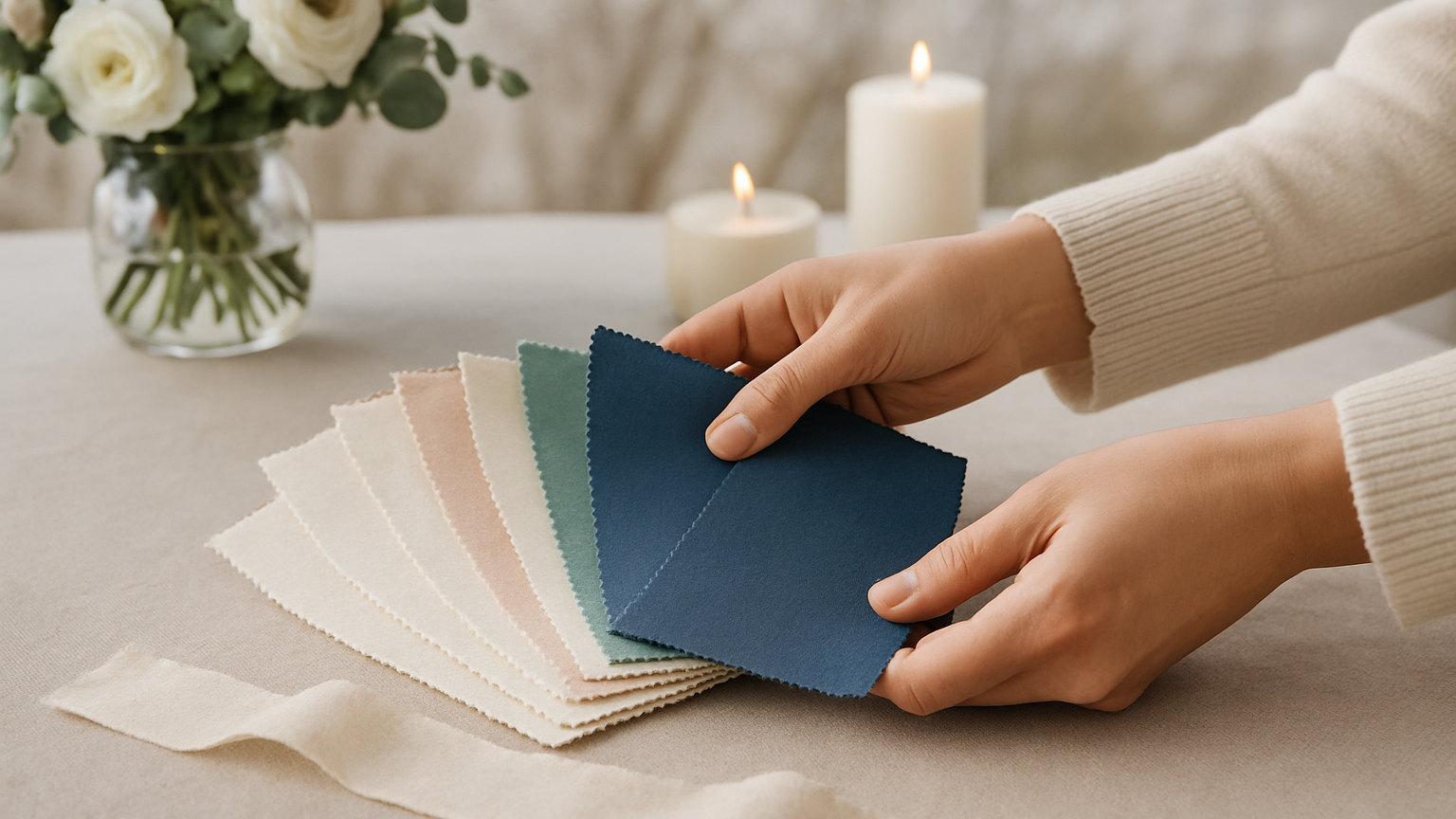
Colours behave differently in photographs than they do in a room, and a few behave badly in ways nobody anticipates. It is worth knowing before a palette is fixed, since the photographs are how most people will see the wedding.
What causes the problem?
Reflected light. A strong colour near somebody face bounces onto their skin, particularly in bright sunlight or under a marquee canopy of that colour.
It is most visible with saturated colours and least visible with muted or neutral ones, which is the main reason muted palettes dominate wedding photography.
Which colours reflect most?
Strong greens and bright yellows are the most noticeable, since both cast a tint onto skin that is difficult to correct afterwards.
That matters most in a green marquee, under a canopy of trees or where bridesmaids in a saturated colour stand close to the couple.
What about very bright colours?
Highly saturated colours can dominate an image and pull attention from the people in it. They also render differently between cameras and screens.
Used as accents they are excellent. Used across a whole room they compete with everything else in the frame.
What disappears in photographs?
Very pale colours against white. A white bouquet against a white dress can vanish, and pale stationery on a white cloth photographs as a blank.
Some definition solves it. Foliage, a darker neutral or a contrasting texture gives an image something to hold on to.
What about black?
It loses detail in photographs and reads as a flat shape, particularly in bright daylight. That is why navy and charcoal are more common than black in menswear.
As an accent or in an evening setting it works well. Across large areas in daylight it flattens.
Which colours are most reliable?
Muted and mid tone colours across the range. Dusty blues, sage, terracotta, mustard, burgundy, soft pinks and warm neutrals all photograph consistently in most light.
They also hold up under mixed lighting, which matters at a wedding that starts in daylight and ends under artificial light.
How does the light change things?
Substantially. Midday sun is harsh and cool, late afternoon is warm and flattering, and artificial light in the evening is warmer again.
A palette chosen under one will look different under the others, which is why testing physical samples in daylight and in warm light is worth ten minutes.
Does the venue affect it?
More than the palette does in many cases. A room with strong existing colour casts that colour into every photograph taken in it.
Ask a photographer who has shot there. They will tell you immediately what the room does to images and it is information no brochure contains.
Should you ask the photographer?
Yes, and it costs two minutes. Send the palette and the venue and ask whether anything concerns them.
They have shot several hundred weddings and will flag a marquee colour or a saturated bridesmaid dress that they know causes work in editing.
Should photographs decide the palette?
Not entirely, and they are worth a consideration. Choose colours you like and check that nothing in the list is known to cause difficulty.
That is usually a small adjustment rather than a rethink, and it is considerably easier before anything is ordered.
What about the bridesmaid dresses specifically?
They are the largest block of colour standing closest to you in most photographs, which makes them the element most likely to cast onto skin.
A muted version of a colour is safer than a saturated one for exactly this reason, and it is a small adjustment rather than a change of scheme.
Should you test it?
Photograph the samples together on a phone in the light you expect. It is a rough test and it reliably catches combinations that go muddy in an image.
Does any of this rule a colour out?
Rarely. It usually means choosing a slightly less saturated version of the colour you wanted, which nobody at the wedding will register and which the photographs will thank you for.


