
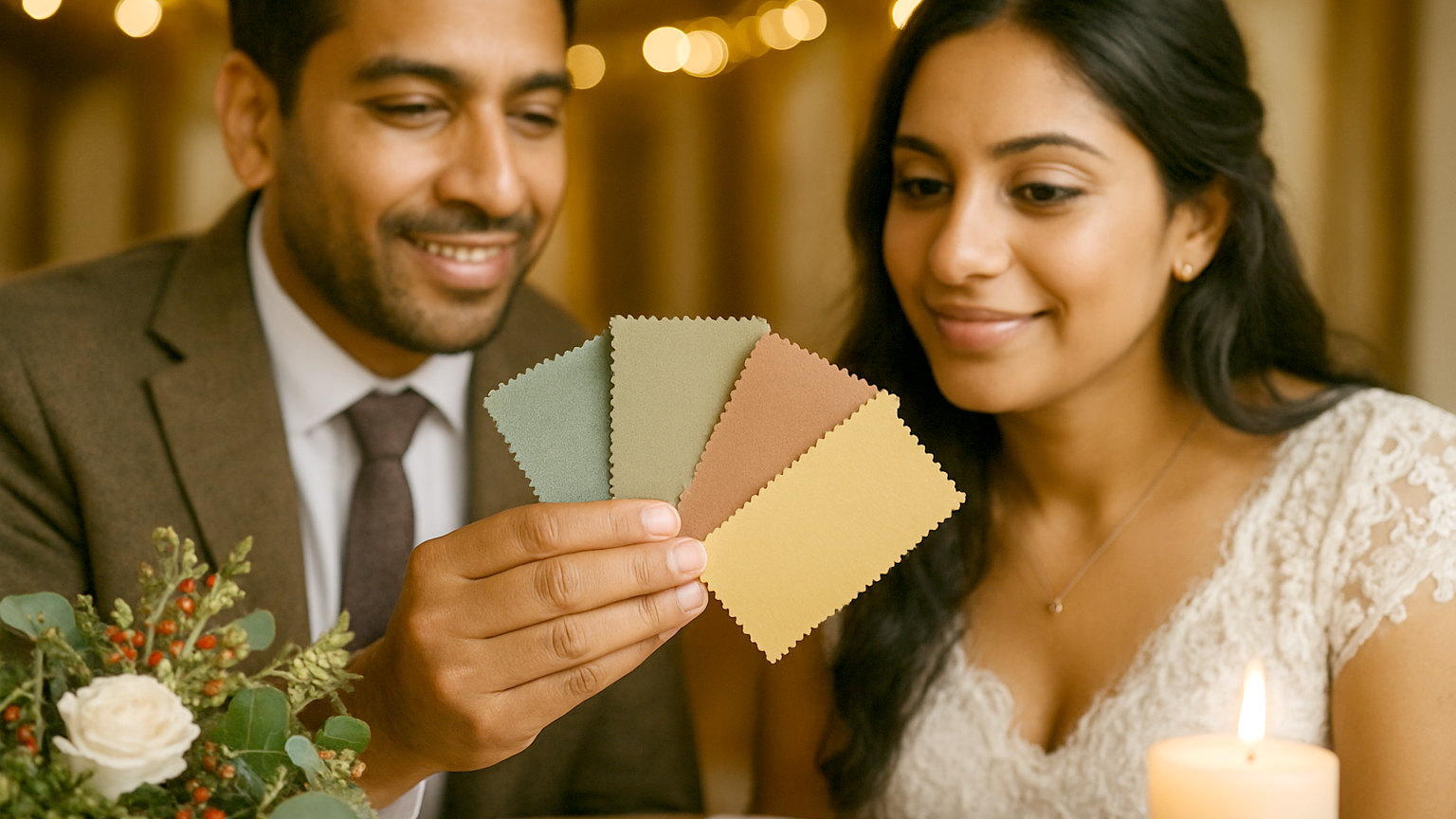
Seasonal colour advice is partly convention and partly practical. The practical part is worth taking seriously, because light and flower availability genuinely differ across the year and both affect how a palette works.
What suits spring?
Soft, fresh and light. Pale yellows, lilacs, soft pinks, fresh greens and white all suit the flat bright light of March through May.
The flowers support it, since tulips, ranunculus, anemones, hyacinths and blossom are all available and all sit naturally in that range.
What suits summer?
Almost anything, which is why summer weddings have the widest palettes. Bright light supports both strong colours and pale ones.
The consideration is reflection rather than convention. Saturated colours in strong sunlight cast onto skin, so muted versions of the same colours are safer.
What suits autumn?
Warm and deep. Terracotta, rust, mustard, burgundy, olive and warm neutrals all suit the low golden light of September and October.
The flowers are abundant and cheap in exactly those tones, since dahlias, chrysanthemums, berries and turning foliage are at their peak.
What suits winter?
Rich and deep, since most of the day happens under artificial light. Deep greens, burgundy, navy, plum and warm neutrals all read well.
Very pale schemes can look washed out under warm artificial light, which is the main practical reason winter palettes tend darker.
Can you ignore the convention?
Largely, yes. A pale scheme in November or a deep one in June are both entirely possible and both look deliberate rather than wrong.
What you cannot ignore is availability. A palette built around peonies in October or dahlias in April will cost a great deal to achieve.
How much does the light really matter?
Considerably. Summer light is bright and cool, autumn light is warm and low, and winter is largely artificial and warmer still.
Test physical samples under the light you will actually have. A colour chosen in a bright June kitchen behaves differently in a candlelit December room.
What is available when?
Spring gives pastels and fresh greens, summer gives everything, autumn gives warm deep tones, and winter gives evergreens, berries and a narrower range of flowers.
Building the palette around what will be good that week is the single cheapest way to achieve it, and it usually looks better too.
Does the venue override the season?
Frequently. A dark panelled room in June wants a different palette from a bright garden in the same month, and the room matters more than the month.
Start from the venue and adjust for the season rather than the reverse.
What works across every season?
Warm neutrals with greenery, which suit every month, every venue and every light. It is the most forgiving scheme available.
Add one accent colour and it stops being plain without becoming difficult to execute.
What should you actually do?
Choose colours you like, check they are achievable in your season, and test physical samples in the light you will have.
Seasonal convention is a useful starting point and not a rule. What matters is availability and light, and both are checkable in an afternoon.
What about a marquee?
The lining colour becomes part of the palette whether or not you chose it, and it casts onto everything beneath it. Ivory is the usual choice for exactly that reason.
Ask what colour the lining is before fixing a scheme, since a coloured canopy affects every photograph taken inside it.
Does the flower budget follow the season?
Closely. A palette matching what is abundant that month costs a fraction of one requiring imports, which makes autumn and late spring particularly good value.
What is the safest seasonal approach?
Choose the colours you like and ask the florist which version of them will be achievable in your month. That usually produces a small adjustment rather than a different palette.
Does the season affect the dresses?
Through fabric more than colour. A heavy velvet in July and a thin chiffon in February are both uncomfortable whatever the shade.


