
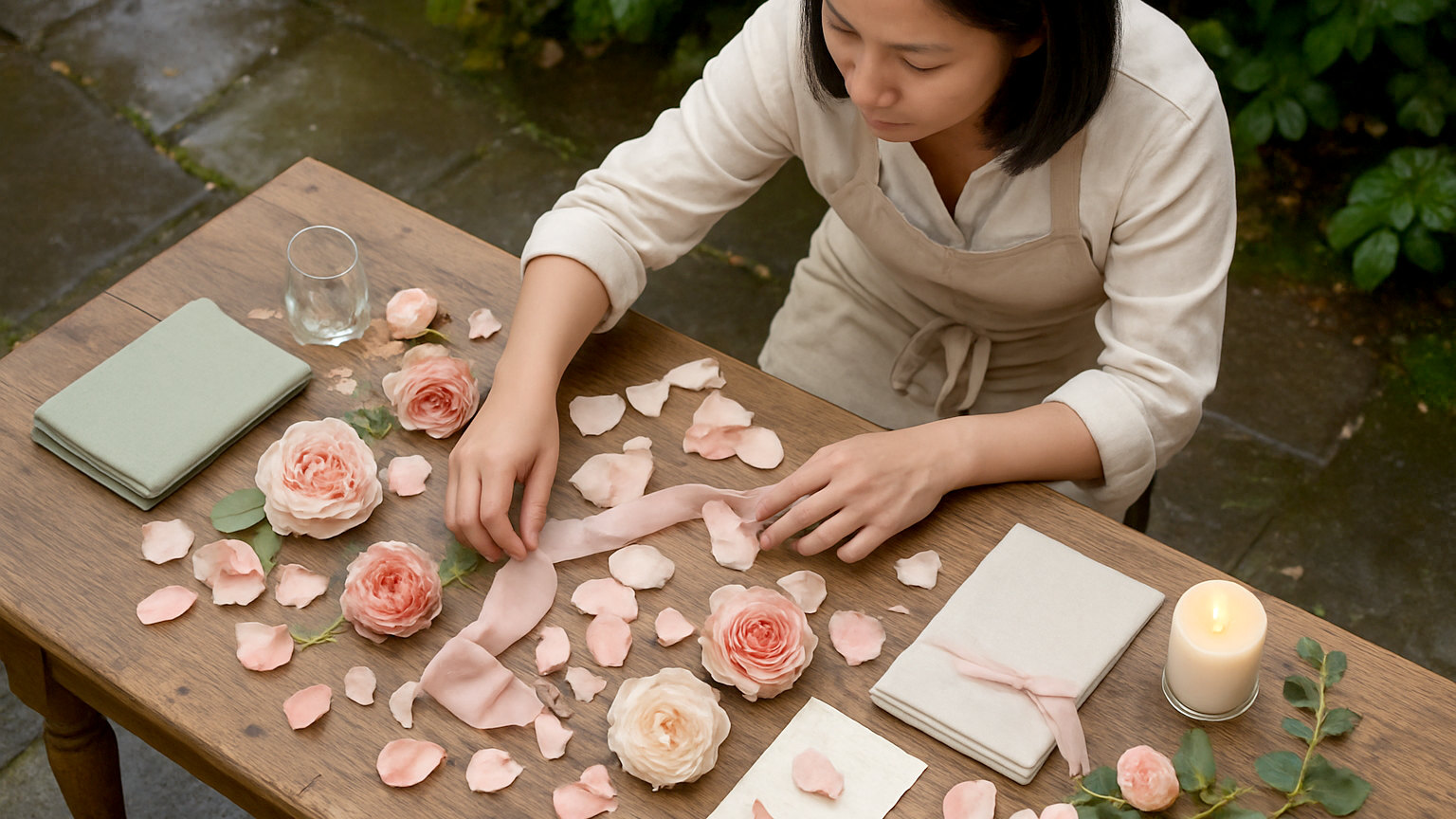
A colour scheme is a decision making tool rather than a requirement. Whether you need one depends on how many decisions you want it to make for you, and a great many weddings do perfectly well without one.
What is a scheme actually for?
Making decisions faster. With a palette, the napkin colour, the tie, the stationery and the flowers are already answered, which removes several dozen small choices.
That is genuinely useful across a year of planning, and it is the main argument for having one.
What does it cost you?
Flexibility. A fixed palette rules out flowers that would have been good that week and occasionally makes something more expensive than it needed to be.
It can also become a checklist, where every element must contain every colour, which is how schemes start to look heavy handed.
What works instead?
A direction rather than a palette. Warm and natural, or cool and pale, or rich and deep, is enough guidance for suppliers without fixing specific colours.
Add greenery and a neutral and it holds together perfectly well. A great many admired weddings are exactly this.
What about seasonal flowers?
The best argument for going without. Telling a florist to use whatever is good that week, in a general tone, produces more for the money and frequently a better result.
A fixed palette removes that freedom, which is the point at which a scheme costs you something real.
Which elements need a decision anyway?
Bridesmaid dresses, ties, stationery and linen all have to be a colour, so those choices exist whether or not you call it a scheme.
What a scheme adds is that they relate to each other. Without one they simply need to not clash, which is a lower bar and easier to meet.
Does the venue decide it?
Frequently. A room with strong existing colour effectively supplies the palette, and the useful work is choosing things that sit with it rather than inventing a scheme.
In that case the scheme exists whether or not you chose it, which is worth recognising.
What about neutrals?
A neutral wedding with greenery is the middle ground and it is the most common answer for couples who do not want a palette.
It coordinates without constraining, it suits any season and it lets the flowers and the venue lead.
Will anybody notice?
No. Guests do not arrive looking for a colour scheme and cannot afterwards describe one. What they register is whether a room feels coherent, which is a different thing.
Coherence comes from consistent tone and good lighting rather than from matching colours.
When is a scheme genuinely helpful?
Where several people are choosing things independently, where a wedding party is buying their own outfits, or where you find open ended decisions difficult.
In all three, a stated palette saves a great deal of correspondence.
What is the honest answer?
Have one if it makes decisions easier and skip it if it feels like an obligation. Both produce good weddings and only one of them is on every planning checklist.
What do you tell suppliers without one?
A direction and a set of physical references, which is most of what a scheme provides anyway. Warm and natural with plenty of greenery is a complete brief.
Florists in particular work happily this way and frequently produce better results for it.
Is it more or less work?
Less at the start and slightly more later, since each decision is made on its own rather than answered in advance.
What do most couples end up with?
Something between the two. A loose direction, a couple of colours that keep appearing, and no formal palette written down anywhere.
That works perfectly well and it is what a great many weddings people admire actually had.
Have one if it makes the year easier and skip it if it does not. It is a tool rather than a requirement, whatever the planning checklists suggest.


