
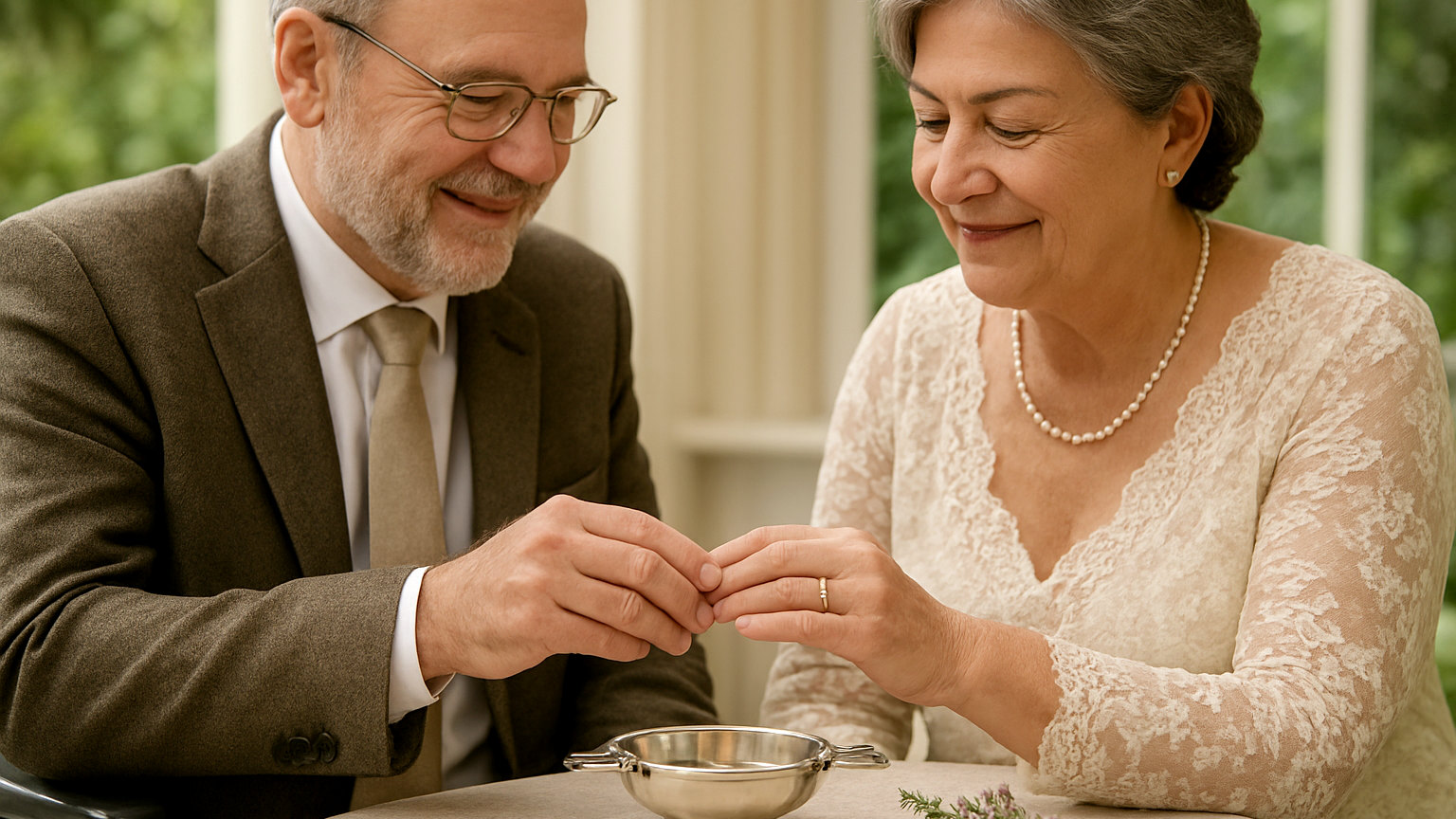
In Britain the wedding ring is worn on the fourth finger of the left hand, and the explanation almost everybody gives for it is not correct. The custom is real and old. The reason usually attached to it is a piece of ancient anatomy that turned out to be wrong.
What is the usual explanation?
That a vein runs directly from the fourth finger of the left hand to the heart, sometimes called the vena amoris. The ring is therefore placed as close to the heart as possible.
It is a pleasing story and it is not anatomically accurate. The veins in the hand are not arranged that way, and there is nothing distinctive about the circulation of that particular finger.
Where did the belief come from?
From classical and medieval understandings of the body, which were sincere attempts at anatomy rather than deliberate invention. Roman and later writers described such a connection, and the idea persisted long after dissection had shown otherwise.
The custom outlived the belief that justified it, which is a common pattern. Once a practice is established, the original reason becomes decorative rather than load bearing.
Are there other explanations?
Several, none of them conclusive. One practical account notes that the fourth finger of the non dominant hand is among the least used, so a ring there is less likely to be damaged or to interfere with work.
Another points to Christian ceremonial, in which the officiant touched successive fingers while naming the Trinity, arriving at the fourth finger for the placing of the ring. Both are plausible and neither is proven.
Do all countries use the left hand?
No, and the split is substantial. Germany, Norway, Poland, Russia, Greece, Spain, Denmark and India among many others traditionally use the right hand, often for religious or cultural reasons.
In some traditions the ring moves. It is worn on the right hand during the engagement and transfers to the left at the marriage, or the reverse. There is no universal practice and no version that is more correct.
How old is the wedding ring itself?
Considerably older than the diamond engagement ring. Rings exchanged at marriage appear across many ancient cultures, and in Roman practice a ring functioned partly as a token of a contract.
The plain metal band as the standard British wedding ring is long established. The materials have changed with fashion and cost, but the shape has been remarkably stable.
When did men start wearing them?
Widely, only in the twentieth century. Before that a wedding ring in Britain was generally worn by the wife alone, and the practice of both partners wearing one became common around and after the Second World War.
The usual account attributes the shift to men serving away from home who wanted a visible reminder, and to the marketing that followed. It is now normal enough that its recency surprises people.
Where does the engagement ring fit?
Traditionally on the same finger, with the wedding ring placed beneath it so that it sits closer to the hand. Many people move the engagement ring to the right hand for the ceremony and return it afterwards.
The diamond as the expected stone is a twentieth century development driven by sustained advertising rather than an old custom, which is worth knowing if the expectation feels burdensome.
Does any of it matter?
Only as much as you want it to. There is no rule, no authority enforcing one, and plenty of people wear a ring on a different finger, on a chain, or not at all because of their work.
The ring is a symbol and symbols work by agreement rather than by correctness. If the fourth finger of the left hand is not practical for you, choosing differently subtracts nothing from what it stands for.
When should rings be ordered?
Around the halfway point of the engagement rather than the final month. Rings that are made rather than bought from stock take six to twelve weeks, and engraving or resizing adds to that.
Rings feel like a late detail and behave like an early one, which is why they appear on more forgotten task lists than almost anything else.


