
Wedding customs vary considerably across Britain and Ireland, and so do the legal frameworks underneath them. Some of the differences are decorative and some determine where and how you are permitted to marry at all.
How does the law differ?
Substantially. Scotland has long permitted marriages in a much wider range of locations and by a wider range of officiants than England and Wales, which is why outdoor and celebrant led ceremonies have been normal there for far longer.
England and Wales, Scotland and Northern Ireland each operate their own notice and registration systems with their own periods and requirements. Confirm the position for the nation you are marrying in rather than assuming, because the differences are practical rather than technical.
What are the distinctive Scottish customs?
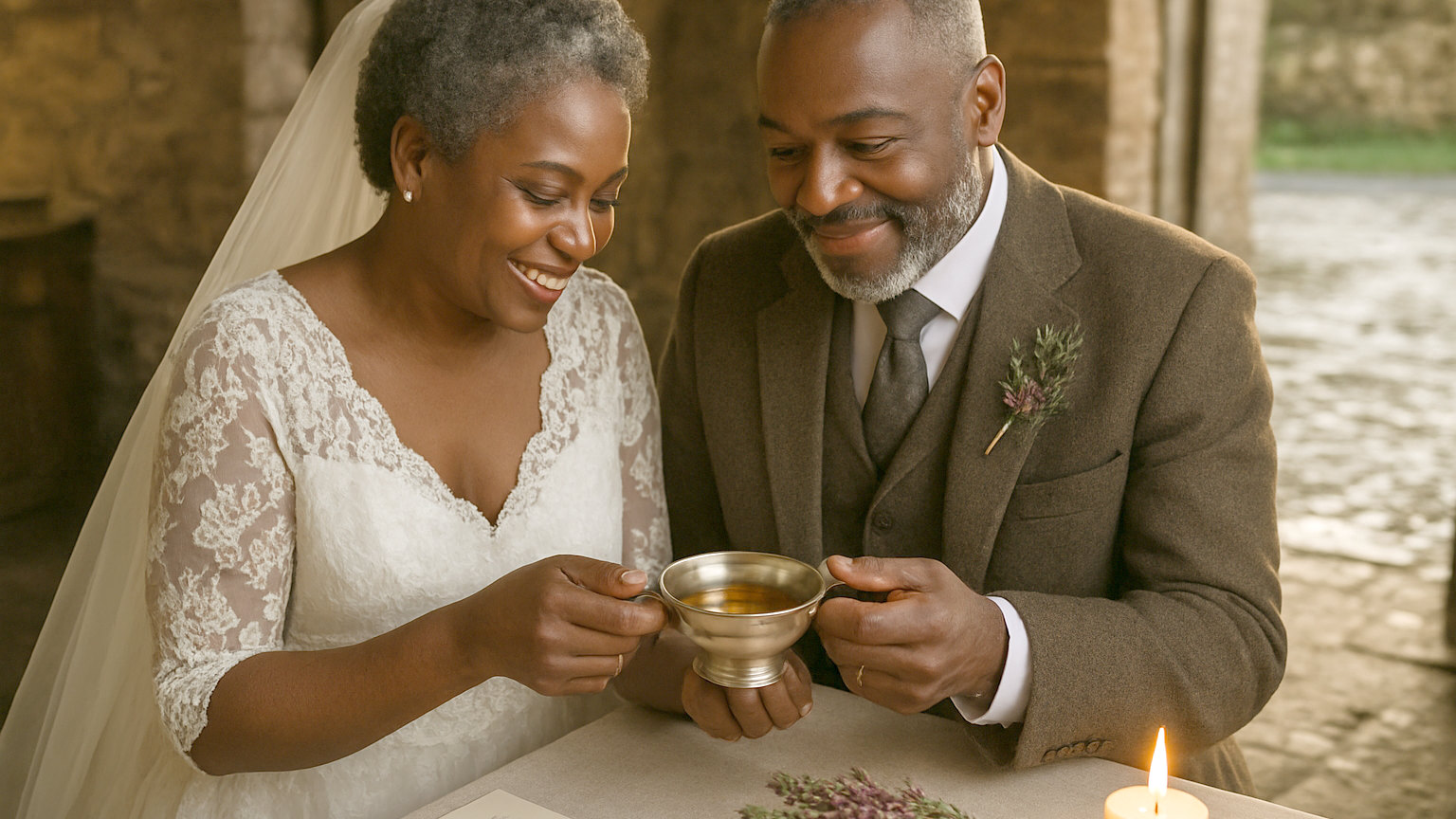
Several, and many are still widely practised. The quaich, a two handled cup shared by the couple, is a common feature of both traditional and modern ceremonies. Highland dress is worn far more routinely than formal wear is in England.
The blackening, in which a couple is covered in various unpleasant substances before the wedding, persists in parts of Scotland, particularly in the north east and the fishing communities. It is not for everybody and it is genuinely traditional.
What about handfasting?
Binding the hands of a couple with cloth or ribbon has strong associations with Scotland and Celtic practice, and it appears in a great many modern ceremonies across Britain now.
Its exact history is debated and much of the current form is a modern reconstruction rather than an unbroken tradition. That does not diminish it, and celebrants across the country include it readily.
What are the Welsh customs?
The lovespoon is the best known, a carved wooden spoon given as a token of affection, which has become a common wedding gift and decorative element. Myrtle in the bouquet is traditional, with cuttings given to bridesmaids to plant.
Ceremonies conducted in Welsh are common in Welsh speaking areas, and bilingual orders of service are entirely routine. Registrars in Wales can conduct ceremonies in Welsh where requested.
What about Northern Ireland and Ireland?
Customs vary between communities and several are widely shared. The Claddagh ring, with its hands, heart and crown, is used as both an engagement and a wedding ring by many.
Northern Ireland has its own marriage law, distinct from both Great Britain and the Republic, including its own notice requirements. Couples marrying across the border should check both jurisdictions carefully.
Are there English regional traditions?
Fewer that survive distinctly, though local practices persist. Tying ribbon or rope across a road to stop a wedding car until a payment is made appears in various forms across the north.
Much of what was once regional in England was flattened by the nineteenth century standardisation of the church wedding and by the national reach of the wedding industry that followed.
Does any of this restrict what you can do?
The legal framework does, and only that. Where you may marry, who may conduct it and what notice is required are all set by law and differ across the nations.
The customs themselves are entirely open. Nobody will object to a quaich at a wedding in Kent or a lovespoon in Aberdeen, and couples with family across several nations frequently combine elements from each.
What should you check before planning?
The notice requirements and permitted venues for the nation where the ceremony will take place, confirmed with the relevant register office rather than from any website. The differences are significant enough to affect the date.
If you are marrying in a different nation from where you live, ask about that specifically, since the residency and notice rules interact and the answer is not always obvious. It takes one phone call and it is the sort of detail that is far better established early than discovered late.
Can you combine traditions from different nations?
Freely, and a great many couples do. A quaich, a lovespoon and a handfasting can all appear in the same ceremony without anybody objecting, and celebrants are generally enthusiastic about it.
Tell the officiant early so the elements can be placed sensibly within the ceremony rather than added at the end. The legal words have to be said in a particular form, and everything else arranges around them.


