
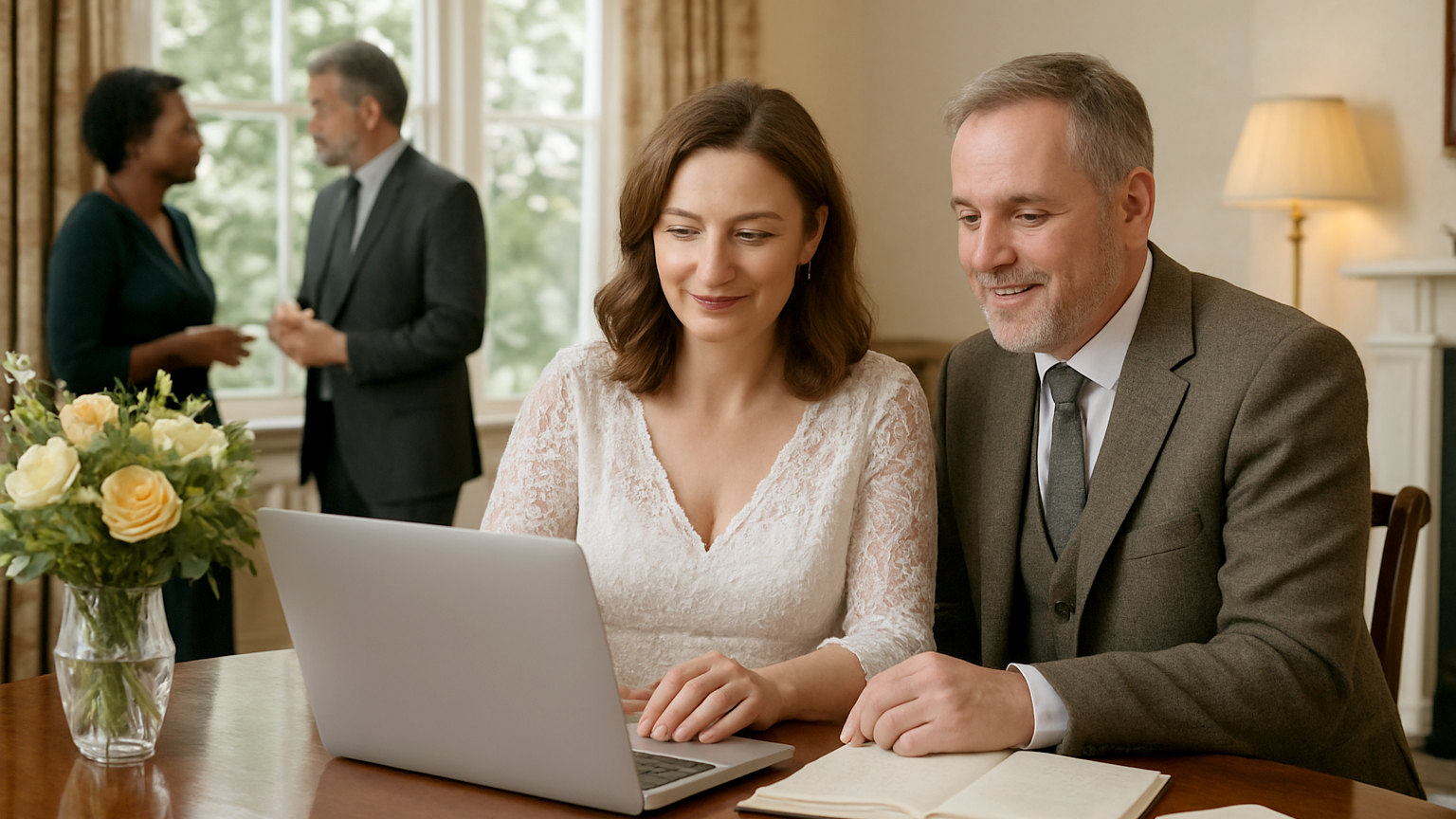
A small wedding is not a large wedding scaled down. Some jobs vanish completely, some are unchanged regardless of numbers, and a few genuinely get harder. Working out which is which stops you either over planning a party for thirty or assuming it will organise itself.
Which jobs disappear?
Most of the logistics of crowd management. Seating plans become straightforward or unnecessary. Table plans, escort cards, multiple service rounds and complex layouts all fall away. So does much of the stationery, since thirty invitations can be handled personally.
Coordination shrinks too. A wedding of thirty rarely needs somebody running the day in the way a wedding of a hundred and fifty does, because the whole room can be told something at once.
Which jobs stay exactly the same?
All the legal ones. Notice, documents, approved premises and officiant availability are identical whether you invite ten people or two hundred, and they are the jobs most likely to be underestimated when the wedding feels informal.
The date, the ceremony content and the photography brief are unchanged as well. A ceremony for twenty takes the same planning as a ceremony for two hundred, and a photographer needs the same information either way.
Which parts get harder?
The guest list, considerably. Cutting from a hundred and forty to a hundred and twenty is a series of small decisions. Cutting to thirty is a series of conversations, because at that size every absence is conspicuous and everybody knows roughly who else was invited.
Venue searching can be harder too. A great many wedding venues have minimum numbers or minimum spend requirements that make a small wedding uneconomic, which pushes you towards restaurants, small halls and private hire, all of which work differently.
How should the venue search change?
Look outside the wedding venue category entirely. Restaurants with a private room, small hotels, village halls, gardens, pubs with function space and members clubs all host small weddings well and frequently cost less than a wedding venue running below its minimum.
Ask about minimum spend early in every enquiry, because it is the single most common reason a small wedding budget does not work. A venue with no minimum and a per head price is usually better value below about fifty guests.
What does the budget look like?
Lower overall, higher per head, and that surprises people. Fixed costs do not shrink with the guest list. Photography, flowers, music, the venue and the cake cost roughly the same for thirty as for a hundred, so they occupy a much larger share.
The upside is that a smaller wedding lets you spend meaningfully on the things guests experience directly. Better food and better drink for thirty people is achievable on a budget that would only stretch to adequate for a hundred and fifty.
What can you do at thirty that you cannot at a hundred?
Feed everybody properly and quickly, seat everyone at one table, have a ceremony where every guest can hear without amplification, and speak to every person there. That last one is the thing couples at large weddings most consistently regret missing.
You can also be far more flexible on the day. A group of thirty can move rooms, move outside, delay the meal or change the plan entirely with a sentence. A group of a hundred and fifty cannot.
How long does a small wedding take to plan?
Less time, though not proportionally less. Expect roughly half the work of a large wedding rather than a fifth, because the fixed jobs dominate once the guest logistics are gone.
Six months is comfortable and three is workable, assuming the legal notice period fits. The main constraint remains the same as for any wedding, which is the availability of the venue and the officiant on the date you want.
What do small weddings most often get wrong?
Assuming informality means the plan can be informal too. A wedding of thirty still has a running order, still needs somebody watching the time, and still has a moment where nobody knows whether to sit down. The scale is smaller but the structure is the same, and the small weddings that feel effortless are almost always the ones somebody thought about carefully.


