
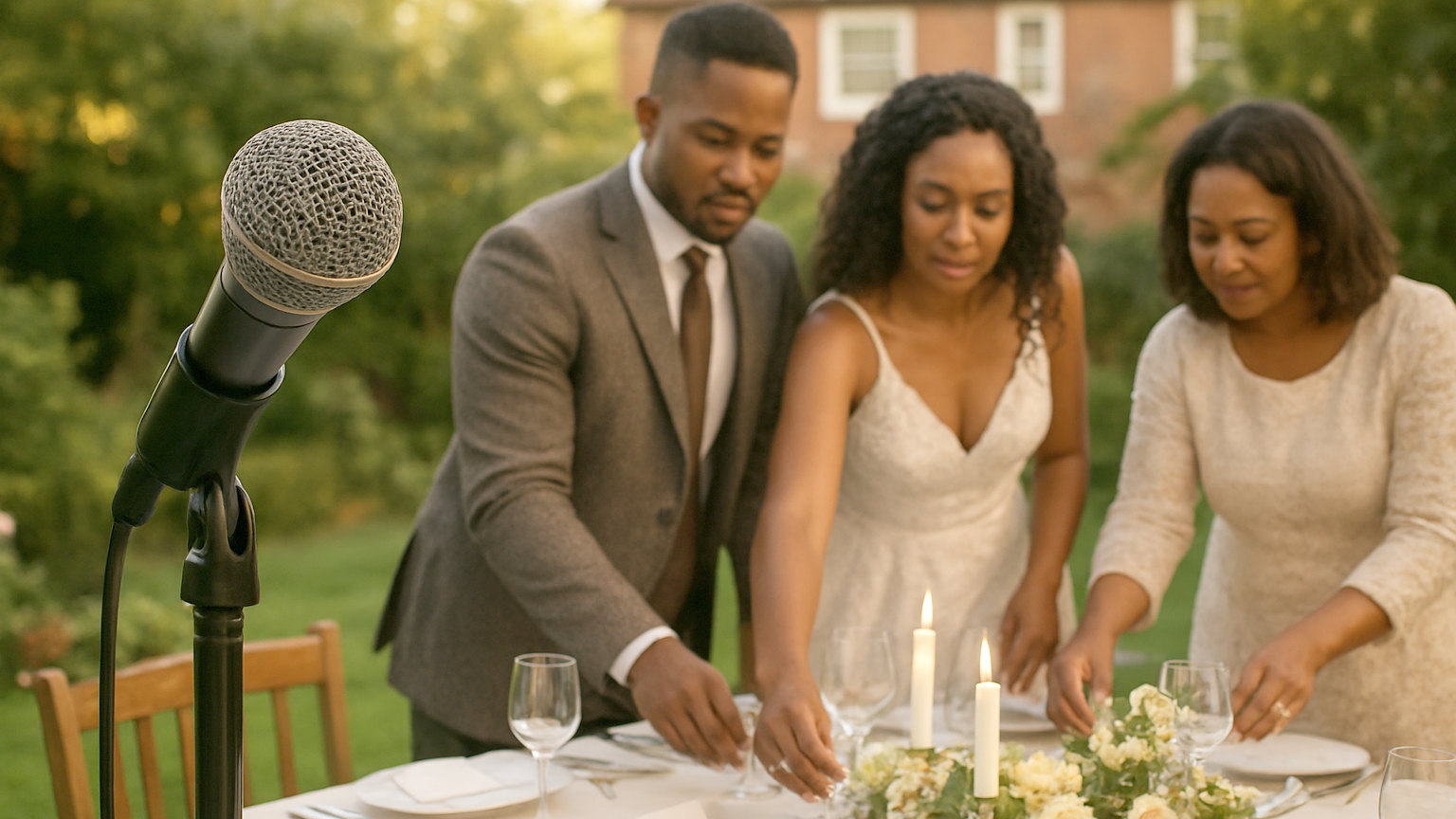
The traditional British speech line up is the father of the bride, the groom and the best man. That arrangement is now one option among several, and a great many weddings look nothing like it.
What is the traditional format?
Three speeches, in that order, delivered after the meal. It reflects a version of a wedding where the bride father hosted and the bride did not speak.
It is still common and it is no longer expected. Nobody at a wedding is surprised by a different arrangement.
Who speaks now?
Whoever you want. Both partners, either partner, parents on either side, the best man, the chief bridesmaid, siblings, friends or nobody at all.
The most common modern arrangement is one parent, both partners together or separately, and the best man or equivalent.
Should both of you speak?
Increasingly common and it is entirely up to you. A joint speech works well and is easier than two solo ones, since you can share the load.
If only one of you wants to speak, that is fine. Nobody counts.
What about a parent from each side?
Sometimes done and it lengthens the block considerably. Two parent speeches plus a couple plus a best man is four, which is at the upper limit.
Where both sides want to speak, ask each to keep it short and place them apart in the order.
How many is too many?
Four is the practical maximum and three is comfortable. Beyond that, guests stop listening regardless of quality.
The total matters more than the number. Three speeches of fifteen minutes each is far worse than five of four minutes.
Can somebody decline?
Absolutely, and they should be able to without awkwardness. Ask privately and make it genuinely easy to say no.
Somebody dreading a speech for a year is a real cost, and a reluctant speaker is rarely a good one.
What if a parent expects to speak?
Have the conversation early rather than letting the assumption stand. Most people are reasonable when asked directly and months in advance.
Where a family expectation is strong, a short speech is a reasonable compromise.
Can somebody speak who is not in the wedding party?
Yes, and it is a good way to include somebody who matters to you. A sibling, a close friend or a grandparent all work.
Choose somebody who will be comfortable rather than somebody who ought to be asked.
What if nobody wants to?
Then have none. A wedding without speeches is unusual and entirely fine, and the time goes to the evening instead.
Alternatively have one short one. Something is not required to be a full set.
How should you decide?
Ask who has something to say and who would enjoy saying it, then keep the total under about twenty minutes.
Guests remember whether the speeches were good and whether they were short, in that order.
When should you ask people?
Several months ahead, so anybody nervous has time to prepare and anybody unwilling can decline comfortably.
Asking a fortnight before is unfair on somebody who will worry about it, and it produces worse speeches.
What should you tell them?
Who else is speaking, the order, the length and when it happens. Four things, sent once in writing.
Telling speakers about each other prevents two people telling the same story, which happens more often than you would expect.
What is the modern default?
One parent, the couple and the best man or equivalent. Three speakers, twenty minutes, and nobody feels left out.
Does anybody mind a different line up?
No. Guests notice the length and the quality far more than who is holding the microphone.
What is the one rule?
Ask people who want to do it, and keep the total under twenty minutes.
What if a speaker drops out?
Shorten the block rather than replacing them at short notice. A speech written in a week is rarely the one you wanted.


