
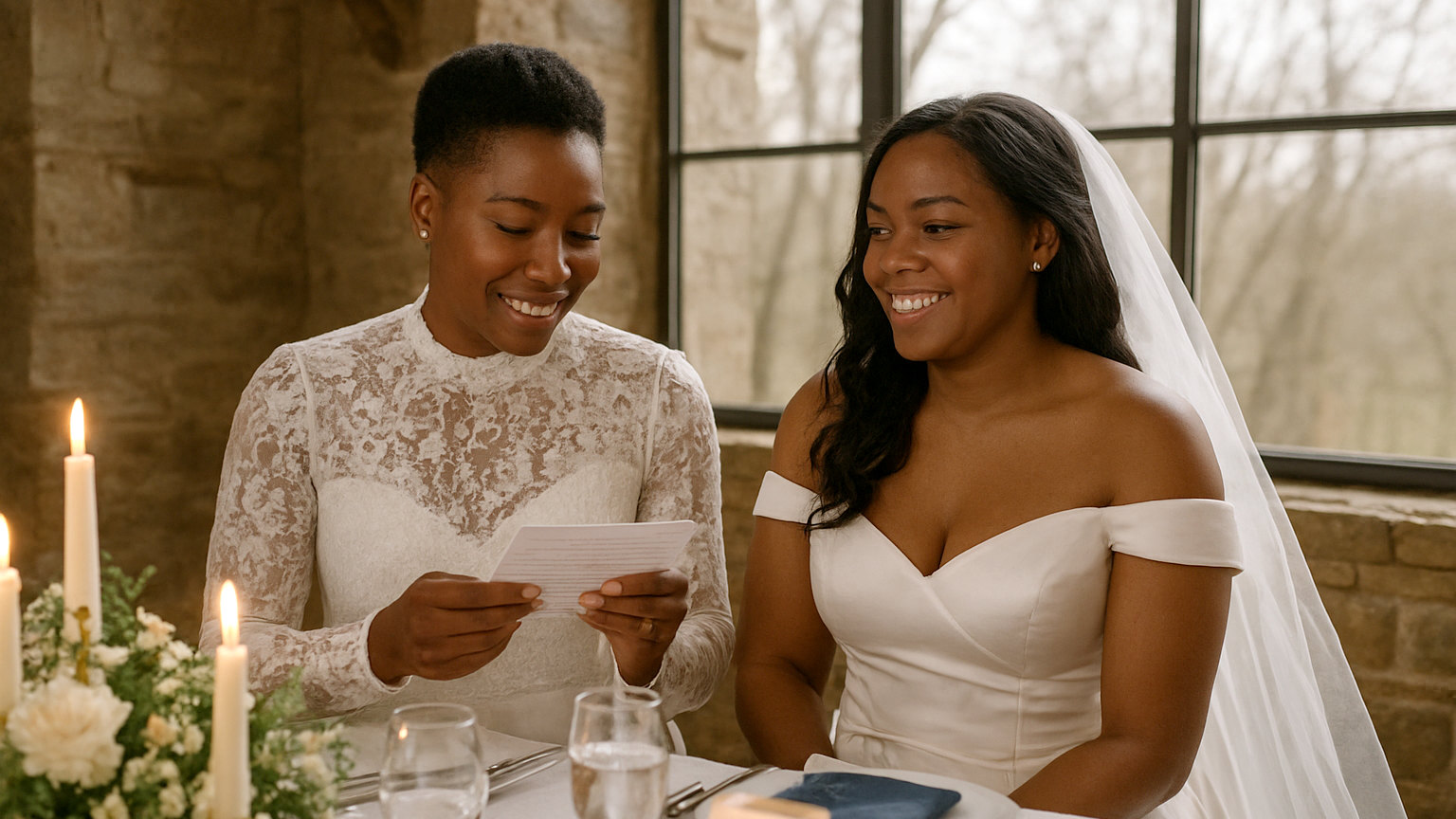
The order of speeches shapes how the whole block feels. The traditional sequence exists for a reason and it adapts easily to a modern line up.
What is the traditional order?
The father of the bride, then the groom, then the best man. Each hands to the next and each has a defined job.
It builds from formal and sentimental towards funny, which is why it works and why the best man goes last.
Why does the best man go last?
Because the funniest speech is hardest to follow. A sentimental speech after a comic one lands flat, and both suffer.
Whoever is most likely to get laughs should be at the end, whatever their role.
What does each speech do?
The first welcomes guests and speaks about the couple. The middle thanks people and toasts. The last entertains and toasts the couple.
Each ends with a toast, which is what signals the handover and keeps the block moving.
How do you adapt it?
Keep the shape rather than the roles. Someone opens and welcomes, the couple thank people, and the funniest goes last.
That structure works with any combination of speakers and any number.
Where do the couple sit in it?
Traditionally in the middle, which is a comfortable position. You are not opening cold and not following the biggest laughs.
If only one of you speaks, the middle is still the easiest place to be.
What if two parents speak?
Separate them rather than placing them together, since two similar speeches back to back feel repetitive.
One at the start and one after the couple is the usual solution.
Who introduces them?
Somebody nominated, whether a toastmaster, the venue coordinator, the DJ or a member of the wedding party.
It should not be either of you. A short introduction of each speaker keeps the block moving and tells guests when to listen.
What about the toasts?
Each speech ends with one, and glasses need to be filled before the block starts rather than during it.
Pouring for a hundred and fifty guests takes time, so tell the venue when the speeches begin.
Should anybody speak twice?
No. It stretches the block and the second contribution is rarely as good as the first.
If somebody has more to say, they should say it in one speech.
What should you write down?
The order, the introducer, the approximate length of each and the total. One line on the running order.
Send it to the venue, the caterer, the photographer and every speaker, so everybody knows when it happens.
What if somebody is very nervous?
Put them earlier rather than later. Waiting through three speeches is considerably harder than going second.
It also means they can enjoy the rest of the block, which is a genuine kindness.
Should the order be announced?
Not in advance to the room, and yes to the speakers and the venue. Guests find out as it happens.
Telling guests roughly how many there are is worth doing, since it sets expectations about the length.
What about handovers?
Each speech ending with a toast does the work naturally. The introducer then names the next speaker and the block keeps moving.
Without that structure the block sags between speeches, which is where the length is felt.
What if there are four speakers?
Keep the shape and shorten everybody. Open with a parent, the couple in the middle, and the funniest last.
Who needs to know the order?
The speakers, the introducer, the venue, the caterer and the photographer. One line on the running order covers all five.
Should anybody be warned they are next?
Yes, quietly, a minute before. Being called unexpectedly is unpleasant and entirely avoidable.
What holds it together?
A toast at the end of each speech and a named introducer between them.
Get the order right and the block carries itself from one speaker to the next.


