
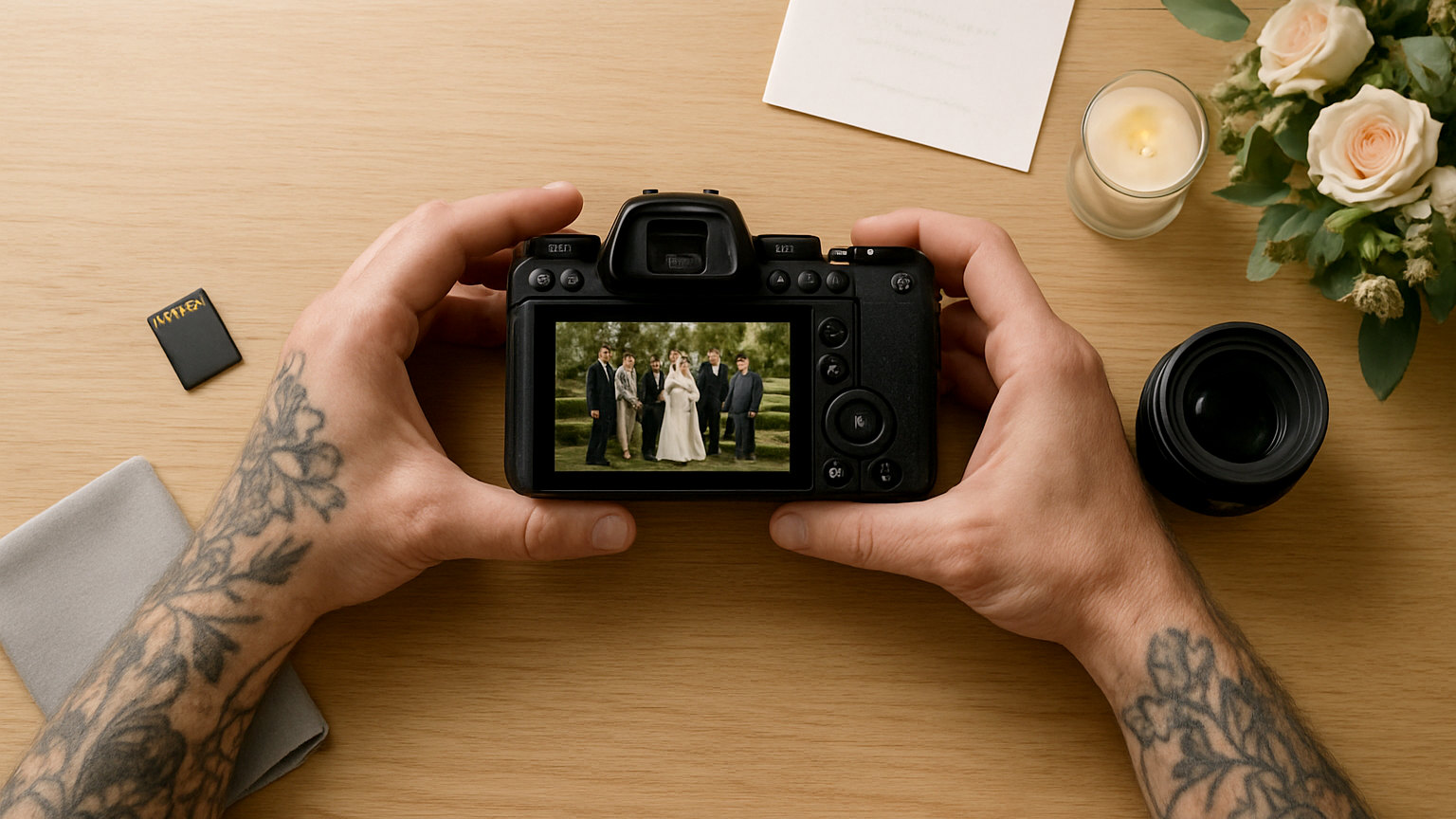
An unplugged ceremony asks guests to put their phones and cameras away for the service. It has become common because of what phones do to the photographs, and asking well matters more than asking at all.
What is the problem?
Guests holding phones appear in a substantial proportion of ceremony images, particularly the walk down the aisle, which is shot straight down a line of seated people.
A phone raised into the aisle also physically blocks the photographer at the one moment that cannot be repeated.
How bad is it?
Photographers raise this more than any other guest behaviour. A screen held up two rows back appears in every frame of the entrance.
It also changes the images of the guests themselves, since a row of faces looking at screens is a different photograph from a row of faces looking at you.
What does unplugged mean?
Usually phones away for the ceremony only, with guests free to photograph everything else. That is the version most couples use and it is easy to accept.
A fully unplugged day is possible and considerably harder to enforce, and most photographers do not ask for it.
How do you ask?
Through the officiant, in a short line at the start of the ceremony, and on a sign at the entrance. Both together works best.
Frame it as wanting to see faces rather than as protecting the photographs, which is warmer and lands better.
What should the wording be?
Short and warm. Something inviting guests to be present with you and to put phones away, with a note that the photographer will share the images.
Promising to share photographs afterwards is the part that makes it easy for guests to comply.
Does it work?
Largely, and it is not universal. Some guests will forget, which is why the spoken reminder at the start matters more than the sign.
Almost nobody objects. It is a widely understood request now and guests generally comply willingly.
Is it rude to ask?
No, and it is your ceremony. Asking politely and explaining why is entirely reasonable and considerably less rude than a guest stepping into the aisle.
Where family would find it odd, a spoken request from the officiant is softer than a sign.
What about the rest of the day?
Guest photographs during the reception and the evening are genuinely welcome and produce images the photographer will not get.
Some couples set up a way to collect them afterwards, which is a nice thing to have and costs nothing.
What about social media?
Worth saying something if you have a preference, particularly about posting before you have seen the professional images.
Say it plainly on the website. Most guests will follow a stated preference and very few will guess it.
What is the practical version?
A sign at the door, a line from the officiant, and phones welcome for everything after the ceremony.
That covers the moment that matters and asks very little of anybody.
What do photographers say?
They raise it more than any other guest behaviour, which is a reasonable indication of how often it affects the images.
Ask yours whether they recommend it at your venue, since the seating layout affects how much difference it makes.
What is the simplest version?
A line from the officiant at the start and a small sign at the door. Nothing else is needed and nothing else works as well.
Does it affect the guests?
Positively, in most accounts. Guests who are not filming tend to be more present, and the photographs of them show it.
What about the aisle specifically?
That is the moment worth protecting. A phone stepping into the aisle blocks the one shot that cannot be repeated.
Ask warmly, ask once through the officiant, and promise to share the photographs. That is all it takes.
Does it need to cover the whole day?
No, and it should not. Guest photographs during the reception and the evening are welcome and capture things the photographer will not.


