
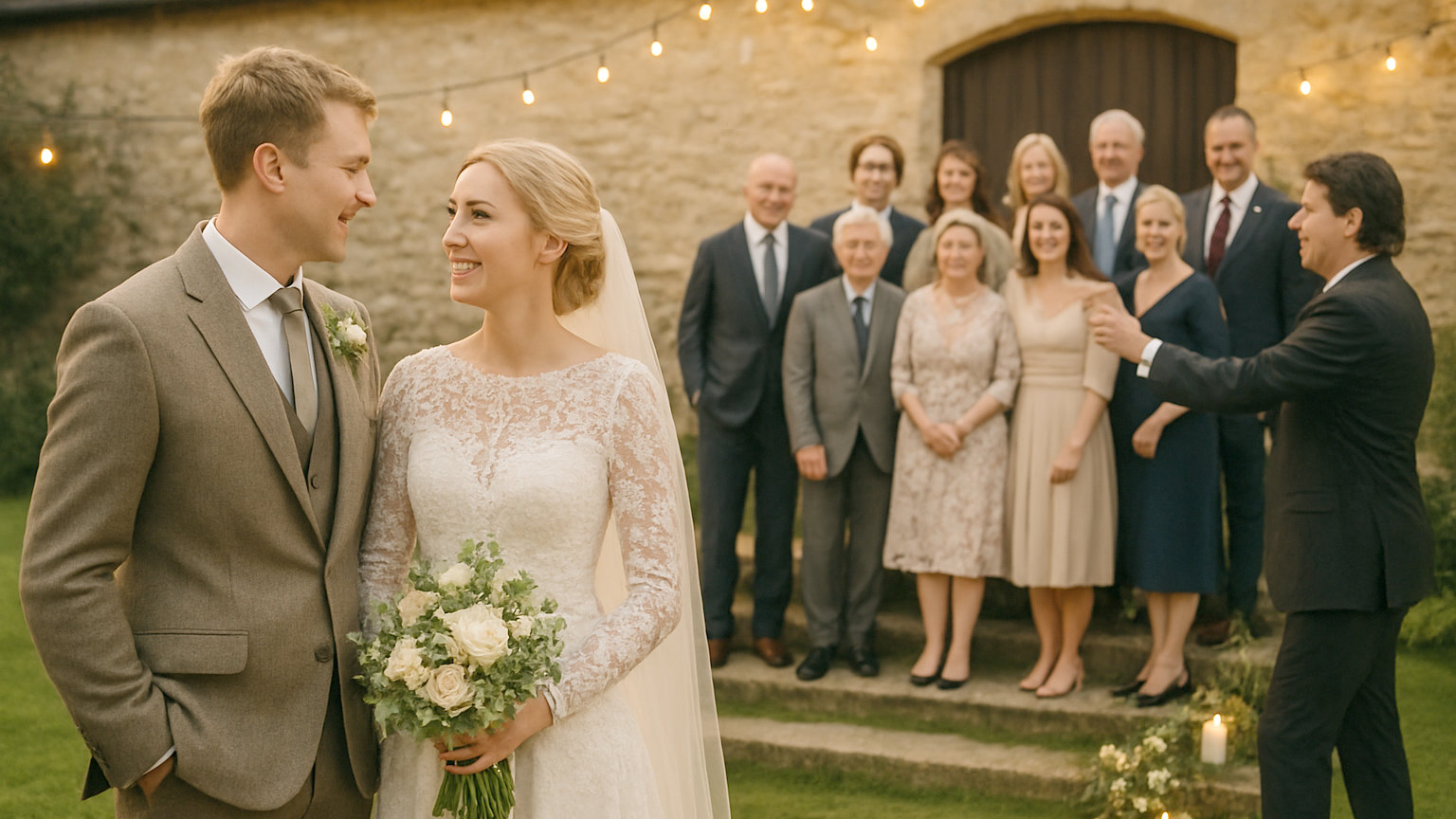
Group photographs are the most common cause of a delayed drinks reception. They take considerably longer than anybody expects, and almost all of the delay is finding people rather than taking the picture.
How long does each one take?
Three to five minutes once the people are assembled, and the assembling is what takes the time. A group of twelve can take ten minutes to gather from a reception.
Plan on five minutes per group as a working figure and you will be roughly right.
How many should you have?
Eight to ten is a sensible maximum, which is thirty to forty minutes. Beyond that the reception is meaningfully shortened and guests notice.
Every additional group is five minutes of your drinks reception, so the list is a time budget rather than a wish list.
Which groups are worth having?
Immediate family on both sides, the two families together, the wedding party, grandparents, and one large group of everybody if the venue allows it.
Beyond that the returns fall away quickly. Friend groups are better captured naturally during the reception.
How do you speed it up?
Write the list in advance, order it so people can leave as they finish, and give it to somebody who knows the families by sight.
That last point is the whole trick. A photographer calling for names into a crowd is slow, and somebody who can point at people is fast.
Who should run it?
A designated person from each side, usually a sibling or a close friend, briefed in advance with the list.
They gather the next group while the current one is being photographed, which halves the total time.
When should they happen?
Immediately after the ceremony while everybody is together, before guests disperse into the reception.
Once people have drinks and have scattered, gathering them again is considerably harder.
Where should they be taken?
Somewhere agreed with the photographer in advance, with a wet weather alternative. It needs space, decent light and a route for guests to reach it.
Announce the location clearly, since guests wandering to find it is another source of delay.
What about difficult family situations?
Tell the photographer in advance, discreetly. Divorced parents, estranged relatives and anybody who should not be in the same frame.
They deal with this constantly and will structure the list so nothing awkward happens in front of everybody.
What about a large group shot?
Everybody together is popular and needs height, space and about ten minutes. Ask whether the venue has a suitable position.
It also needs somebody to marshal a hundred and fifty people, which is a genuine job rather than a request.
What should you send the photographer?
The list with full names, the location, the timing and the name of whoever is marshalling.
Send it a fortnight before rather than on the day. It is the single most useful document you can give them.
What if somebody is missing?
Move on and come back, rather than holding a group of twelve while somebody is found. The marshal collects them and you retake it later.
Waiting for one person is where the schedule is lost, and it happens at almost every wedding.
Should you announce them?
Yes, clearly, so guests know it is happening and where. An announcement from the officiant as people leave the ceremony works well.
Guests who do not know tend to wander, which is the other main source of delay.
How many people can be in one?
Beyond about twenty, faces become small and the photograph loses its point. Larger than that is really a whole group shot rather than a family one.
What is the single biggest saving?
A shorter list. Cutting from fifteen groups to eight returns thirty five minutes to your own drinks reception at no cost.
Where should guests go meanwhile?
Into the drinks reception with something to eat, so they are not standing about waiting to be called. That single arrangement makes the delay invisible.


