
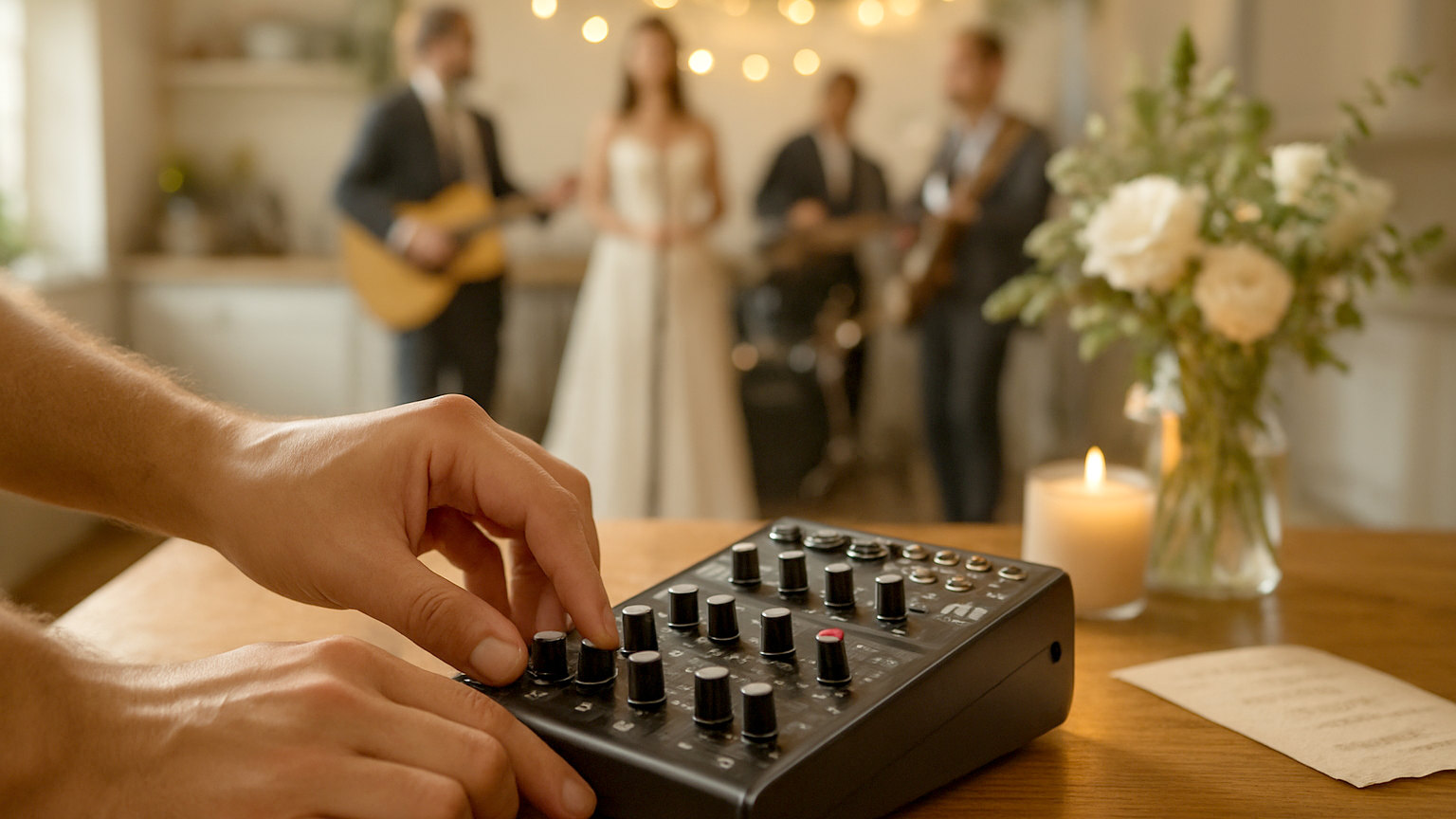
A band and a DJ do different jobs at a wedding and cost very differently. Neither is better, and the venue frequently narrows the choice before you have made it.
What does a band give you?
Energy and occasion. Live music is an event in the room rather than a soundtrack, and guests respond to people playing in a way they do not to a playlist.
It is also the thing people mention afterwards more often than almost anything else in the evening.
What are the drawbacks?
Cost, space, breaks and repertoire. A band plays what it plays, takes breaks between sets, needs a real footprint and costs substantially more than a DJ.
They also need setting up and sound checking, which takes an hour or more and has to fit into the schedule.
What does a DJ give you?
Continuity and range. A DJ plays anything, reads the room, takes requests and runs without breaks from the first dance to the end.
They also handle announcements, which is genuinely useful, and they cost considerably less.
What are the drawbacks?
Less spectacle, and enormous variation in quality. A good DJ reads a room brilliantly and a poor one plays a generic playlist at the wrong volume.
The difference between the two is larger than the difference between a good and average band.
Can you have both?
Commonly, and it is the usual arrangement at larger weddings. The band plays two sets and a DJ covers the breaks and the end of the night.
Many bands include a DJ service between sets, which is simpler and cheaper than booking separately. Ask.
How does the venue affect it?
Substantially. A sound limiter set restrictively can make a full band with drums unworkable, and some venues have space or access constraints.
Establish the limiter level, the stage space and the load in access before booking any act.
What about the finish time?
The curfew determines how much music you are buying. A band playing two sets needs an evening long enough to fit them with a break between.
Check when music must stop and work backwards, since a late first dance compresses everything.
What does each cost?
Bands cost several times what a DJ does, and both vary widely by size and reputation. Cost is covered in more detail elsewhere on this site.
Ask what the fee includes, particularly the PA, lighting, travel and any DJ service between sets.
What about an acoustic option?
A smaller act, a solo performer or a duo works well where a full band is too loud, too large or too expensive.
It suits a restrictive limiter, a smaller room and a wedding where the evening is more relaxed than a full dance floor.
How should you decide?
Start with the venue constraints, then the budget, then what you actually want the evening to feel like.
If dancing matters most, a band or a genuinely good DJ. If the evening is more about people talking, something smaller is a better use of the money.
What about the ceremony and reception?
Different again, and usually a separate act. A string trio or an acoustic performer during the reception is a common addition to an evening band.
Some bands offer daytime musicians from the same group, which is simpler and cheaper than a second booking.
When should you book?
Nine to twelve months out for a popular act on a summer Saturday, in the same window as the photographer.
What should you check before either?
The sound limiter level, the stage space, the load in access and the curfew. Those four constrain the choice more than taste does.
What is the safe default?
A band for two sets with a DJ covering the breaks and the end, which is why so many weddings arrive at exactly that arrangement.
Whichever you choose, tell them the limiter level and the curfew before booking. Those two determine what is possible.


