
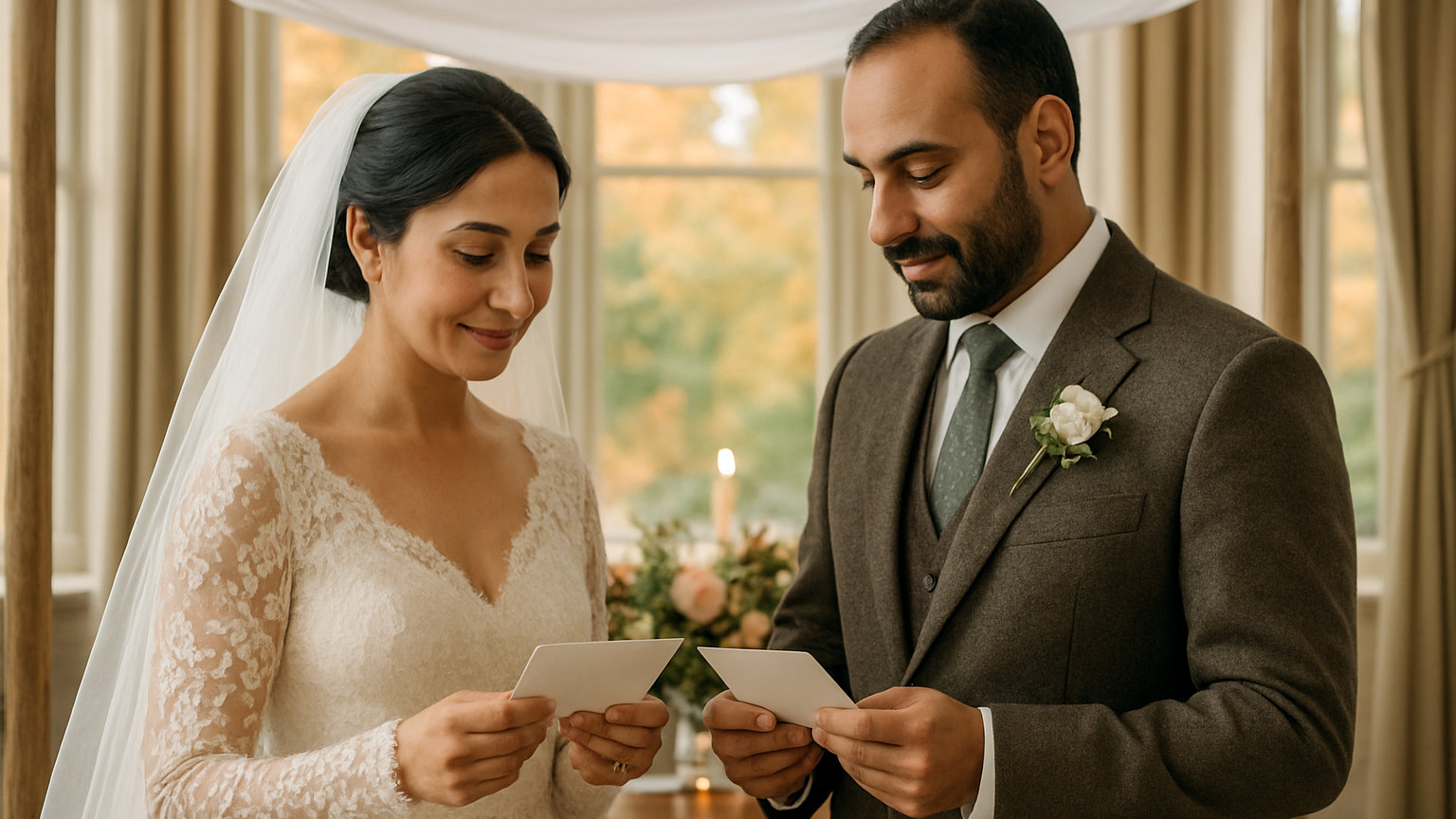
Personal vows are possible at some ceremonies and restricted at others, and the difference is worth establishing before you start writing. What you can do also varies by district, so ask early.
What is legally required?
At a civil ceremony, a set form of declaratory and contracting words that cannot be altered. The registrar provides approved options.
Those words are the marriage. Anything personal sits alongside them rather than replacing them.
Can you add personal vows?
Frequently, and practice varies by district. Some registrars accommodate additional promises readily and others are more restrictive.
Ask your register office directly and submit the wording in advance. Religious content is not permitted whatever else is allowed.
What about a celebrant ceremony?
No restrictions at all. You can write whatever you want, of any length, and the celebrant will help you shape it.
That freedom is one of the main reasons couples choose a celebrant, and it is where personal vows work best.
How long should they be?
A minute each is plenty and ninety seconds is long. Two people speaking for three minutes each is six minutes of a twenty five minute ceremony.
Time them aloud, standing up, at the pace you will actually speak, which will be faster than you expect.
How do you write them?
Make promises rather than statements. Specific commitments about how you will behave land far better than descriptions of how you feel.
Two or three concrete promises, one shared memory and a closing line is a complete structure and it works.
Should they match?
Agree the length, the tone and roughly the structure, then write separately. That prevents one person delivering three minutes of poetry after ninety seconds of jokes.
Whether you read each other drafts is entirely up to you. Many couples do not and the surprise is part of it.
How much humour?
Some, and less than you think. A line or two of lightness works well and a comic routine sits oddly in the middle of a ceremony.
The room is emotional rather than a comedy audience, and jokes land differently there.
How do you deliver them?
Read them from a card rather than memorising. Nobody minds, everybody expects it, and memory is unreliable in that moment.
Print them in large type and give a copy to somebody else in case yours goes missing.
What if you become emotional?
Very common, and guests find it moving rather than awkward. Pause, breathe, and continue. Nobody is judging the delivery.
Having somebody hold a spare copy means somebody can prompt you if you genuinely cannot continue.
Do you have to?
No. The standard words are used at the great majority of weddings and there is nothing lesser about them.
Personal vows suit people who want to speak and are difficult for people who do not. Choosing the standard form is a legitimate decision rather than a missed opportunity.
When should you write them?
A few weeks out rather than the night before, so there is time to revise and to practise reading them aloud.
Write a first version early and leave it. The second attempt is almost always better and considerably shorter.
Who should see them?
The officiant, for approval where required, and nobody else unless you want them to. Many couples keep them private until the day.
What should you avoid?
Inside jokes that exclude the room, lists of qualities, and anything longer than a page. All three are common in first drafts.
What if only one of you wants to?
Then use the standard words for both. Personal vows from one person and set words from the other is uncomfortable for everybody in the room.
Should you practise?
Aloud, standing, several times. It reduces the speed at which you will deliver them and it is the single most effective preparation.
Whichever you choose, the standard words carry exactly the same meaning and have done for a very long time.


